- Our Services
- Capital Gains Tax (Save Tax on Property Sale)
- Save Capital Gains Tax (Section 54 / 54F)
- Section 50C (Stamp Duty Rule)
- CGAS Scheme
- Fair Market Value (FMV) for Capital Gains 2001
- Joint Property Sale Tax
- NRI Taxation (Property & ITR)
- TDS on NRI Property
- NRI Avoid DTAA/ ITR Filing
- Repatriation
- NRI Property Sale Tax
- Income Tax Notice Help ⚡
- Scrutiny Cases
- Income Tax Notice Reply
- GST Notices
- Tax Notice 143
- Calculate Capital Gains Tax (Free Tool)
- Company / LLP Registration
- GST Registration & Filing
- ITR Filing Services
- About CA Shiwali
- Tax Blog/ Guide
- Contact
Section 54 & 54F Exemption – Capital Gains Tax on Property
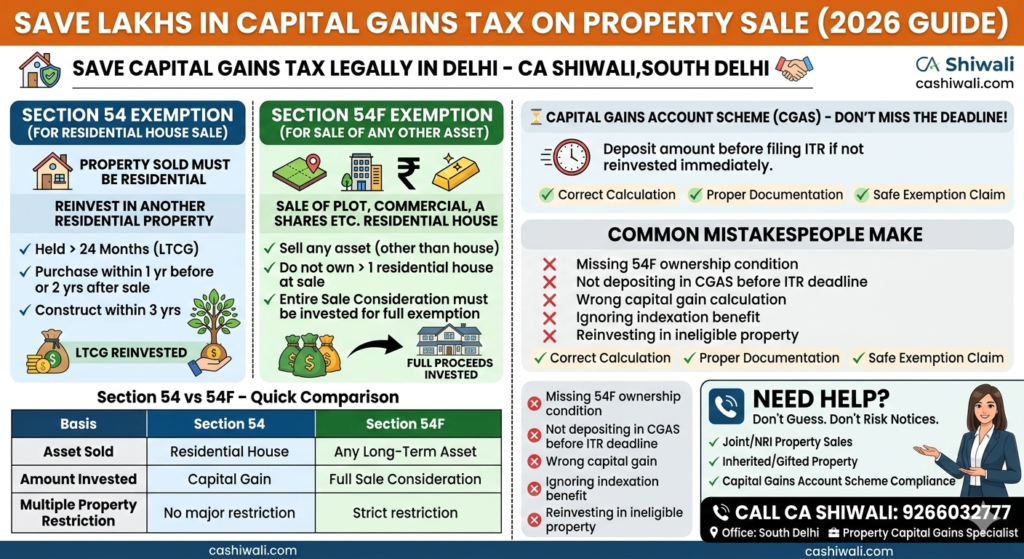
Section 54 & 54F Exemption – Capital Gains Tax on Property
Selling a property in India may result in long-term capital gains tax, but taxpayers can legally reduce or eliminate this tax by claiming exemption under Section 54 and Section 54F of the Income Tax Act.
These provisions allow property sellers to reinvest capital gains or sale proceeds into residential property and claim tax exemption if certain conditions are met.
In this guide, we explain:
• How Section 54 works
• How Section 54F works
• Eligibility conditions
• Capital Gains Account Scheme (CGAS) rules
• Common mistakes to avoid
Section 54 / 54F – Quick Summary
• Section 54 – Applies when selling a residential house
• Section 54F – Applies when selling any long-term asset
• Reinvestment required in residential property in India
• Time limits: 1 year before, 2 years after purchase, 3 years construction
• Unused amount must be deposited in CGAS before ITR filing
At CA Shiwali – South Delhi, we help property owners, investors and NRIs plan property transactions and legally reduce capital gains tax through proper documentation and tax planning.
📞 Call Now: 9266032777
📍 Serving: South Delhi, GK, Hauz Khas, Saket and surrounding areas
What is Section 54?
Section 54 allows exemption from Long-Term Capital Gains (LTCG) when:
You sell a residential property
You reinvest the capital gain into another residential property in India
Key Conditions – Section 54
Property sold must be a residential house
Capital gain must be long-term (held more than 24 months)
New house must be:
Purchased within 1 year before or 2 years after sale
OR constructed within 3 years
Amount not used before ITR filing must be deposited in Capital Gains Account Scheme (CGAS)
Example – Section 54 Capital Gains Exemption
Suppose you sell a residential property for ₹1.2 crore and your long-term capital gain is ₹40 lakh.
If you purchase another residential property worth ₹40 lakh or more, you can claim full exemption under Section 54 and avoid paying capital gains tax.
If you invest ₹25 lakh, only that portion of the gain will be exempt and the remaining amount will be taxable.
What is Section 54F?
Section 54F applies when:
You sell any asset (plot, commercial property, shares etc.)
And invest the sale proceeds in a residential house
Key Conditions – Section 54F
You should not own more than 1 residential property at the time of sale (other than new one)
Entire sale consideration must be invested to get full exemption
Same 1 year / 2 year / 3 year rule applies
Section 54 vs 54F – Quick Comparison
| Basis | Section 54 | Section 54F |
|---|---|---|
| Asset Sold | Residential House | Any Long-Term Asset |
| Amount Invested | Capital Gain | Full Sale Consideration |
| Multiple Property Restriction | No major restriction | Strict restriction |
Capital Gains Account Scheme (CGAS)
If you cannot invest immediately, you must deposit the amount in the Capital Gains Account Scheme before filing ITR.
Many taxpayers miss this deadline and lose exemption benefits.
We ensure:
✔ Correct calculation
✔ Proper documentation
✔ CGAS compliance
✔ Safe exemption claim
Calculate Capital Gains and Section 54 Exemption
Free Capital Gains Calculators
Capital Gains Property Calculator
Before claiming exemption under Section 54 or Section 54F, you must calculate the capital gains arising from the property sale.
Use our Capital Gains Property Calculator to estimate the taxable gain from selling property.
➡ Use the Capital Gains Property Calculator
Capital Gains Indexation Calculator
Indexation adjusts the purchase price of property for inflation using the Cost Inflation Index (CII).
Use our Capital Gains Indexation Calculator to determine the indexed cost of acquisition.
➡ Use the Capital Gains Indexation Calculator
CGAS Deposit Calculator
If the capital gains are not reinvested before filing the income tax return, taxpayers may deposit the amount in the Capital Gains Account Scheme (CGAS) to claim exemption.
➡ Use the CGAS Deposit Calculator
Section 54 Exemption Calculator
Section 54 allows exemption from capital gains tax when the sale proceeds are invested in another residential property.
➡ Calculate exemption using the Section 54 Calculator
Section 54F Exemption Calculator
Section 54F provides exemption when capital gains from non-residential assets are invested in a residential property.
➡ Calculate exemption using the Section 54F Calculator
Common Mistakes People Make
Missing 54F ownership condition
Not depositing in CGAS before ITR deadline
Wrong capital gain calculation
Ignoring indexation benefit
Reinvesting in ineligible property
Even a small mistake can cost lakhs in tax.
Special Capital Gains Cases We Handle
At CA Shiwali, we assist clients with complex capital gains situations such as:
• Joint property sales
• NRI property sales in India
• Inherited property capital gains
• Gifted property taxation
• Multiple property transactions
• Builder delayed possession cases
• Capital gains on property purchased before 2001
Builder agreement capital gains
Why Consult CA Shiwali in South Delhi?
Property tax specialist
Focused on capital gains planning
Local Delhi property transaction expertise
Practical tax-saving strategies
Transparent consultation
📞 Book Consultation Today – 9266032777
Frequently Asked Questions (FAQs)
1. Can I buy two properties under Section 54?
In certain cases, you can claim exemption for two properties once in a lifetime, subject to conditions.
2. What happens if I sell the new property within 3 years?
The exemption claimed earlier may be reversed and taxed.
3. Is stamp duty value considered?
Yes, under Section 50C, stamp duty value may be considered for capital gains calculation.
4. Can NRIs claim Section 54?
Yes, NRIs can claim Section 54 and 54F subject to conditions.
5. What if construction is not completed in 3 years?
Exemption may be withdrawn. Proper planning is essential.
Save Lakhs in Capital Gains Tax
Don’t guess. Don’t risk notices.
Plan your property reinvestment properly.
Related Capital Gains Guides
Posted on Google
 Zahid Khan
Trustindex verifies that the original source of the review is Google.
Very good ,smooth functioning and good professional peoplePosted on Google Gautam PandayExcellent Chartered Accountant! They are highly professional, knowledgeable, and always provide accurate guidance. The entire process was smooth and hassle-free. I truly appreciate their prompt support and transparency. Highly recommended for GST, Income Tax, and accounting services.Posted on Google
 road.to.princeVery nice and Co-oprativePosted on Google
 Harish DhullVery professional and answer queries properly.Posted on Google
 Neeraj Ram
Trustindex verifies that the original source of the review is Google.
Shiwali ji is very polite , truthful services provided by her , filings itr as my 1st experience went well. ThanksPosted on Google Kirpal BishtVery good experience, doubts were cleared by Ms Shiwali, and the process was done quickly….Posted on Google
 Shivam SinghThe firm's services are very professional and delivered on time. The team's guidance has been very clear and helpful, which has greatly assisted in managing our financial affairs.Verified by TrustindexTrustindex verified badge is the Universal Symbol of Trust. Only the greatest companies can get the verified badge who has a review score above 4.5, based on customer reviews over the past 12 months. Read more
Get Free CA Consultation (Response Within 10 Minutes)
Fill the form below and we’ll contact you shortly.
Exclusive NRI Offer
Free 15-Minute Property Tax Consultation
Planning to sell property in India? Confused about 20-30% TDS or Repatriation? Speak directly with CA Shiwali Dagar and get clarity on your tax-saving strategy. (Value: ₹5000+).
Claim Free Consultation (WhatsApp) No thanks, I'll figure it out myself.Save Lakhs in Capital Gains Tax
Strategic Section 54 & 54F Exemption Planning.
Reinvesting your sale proceeds into a new home? We ensure 100% compliance with Section 54/54F timelines, CGAS deposit rules, and ownership conditions to legally eliminate your tax liability.
✓ Section 54 (Residential to Residential)
✓ Section 54F (Any Asset to Residential)
✓ CGAS Deposit Deadline Tracking
✓ Multi-Property Ownership Strategy
⚡ Secure Your Exemptions | South Delhi Experts | Serving Online and Offline.