phone
+91-9266032777
email
CaShiwalidagar@gmail.com
Capital Gains When Property is Sold Below Circle Rate (2026 Guide)
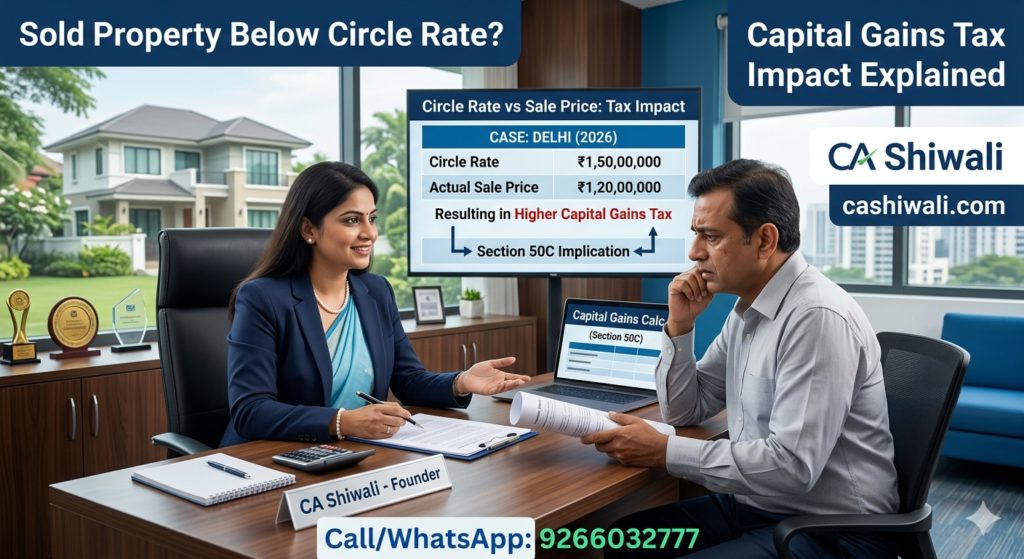
Capital Gains When Property is Sold Below Circle Rate (2026 Guide)
If you sell a property below circle rate, you cannot simply pay tax on actual sale price.
Under Indian tax law, circle rate (stamp duty value) may be considered as your sale value — even if you received less money.
This creates higher capital gains tax, unexpected notices, and confusion for property sellers.
In this guide, CA Shiwali explains:
What happens if you sell property below circle rate
How Section 50C applies
When you can challenge stamp duty value
Practical ways to reduce tax legally
📌 What is Circle Rate?
Circle rate (also called stamp duty value) is the minimum value fixed by the government for property registration.
Even if your actual deal is lower, the tax department may ignore it.
👉 Example:
Actual Sale Price = ₹70 lakh
Circle Rate Value = ₹90 lakh
Tax may be calculated on ₹90 lakh (not ₹70 lakh)
⚖️ Section 50C of Income Tax Act (Core Rule)
Section 50C states:
If sale consideration is less than stamp duty value, then stamp duty value will be treated as full value of consideration for capital gains calculation.
📊 Capital Gains Calculation (Example)
Purchase Price = ₹40 lakh
Sale Price (actual) = ₹70 lakh
Circle Rate = ₹90 lakh
👉 Capital Gain will be calculated as:
Sale Value (considered) = ₹90 lakh
Less: Cost = ₹40 lakh
Capital Gain = ₹50 lakh
Less: Cost = ₹40 lakh
Capital Gain = ₹50 lakh
⚠️ Even though you received only ₹70 lakh, tax is on ₹90 lakh.
⚠️ 5% / 10% Safe Harbour Rule
Good news — small differences are allowed.
If circle rate is within:
10% of actual sale price (current rule)
Then actual sale price can be accepted.
👉 Example:
Sale Price = ₹100 lakh
Circle Rate = ₹108 lakh
Since difference <10%, ₹100 lakh will be accepted
🧾 What If Circle Rate is Unfairly High?
You are NOT helpless.
You can challenge it.
🏢 Reference to Valuation Officer (Very Important)
If you believe circle rate is too high:
You can request Assessing Officer to refer case to a valuation officer (DVO).
If DVO gives lower value → that value will be used.
🧠 Real-Life Situations Where This Happens
Distress sale (urgent money need)
Property dispute
Old / damaged property
Legal issues or encroachment
Market slowdown
🚨 Income Tax Notice Risk
Selling below circle rate may trigger:
Scrutiny notice
Capital gains mismatch
High-value transaction alerts
💡 How to Save Tax Legally
Use Section 54 / 54F exemption
Challenge stamp duty value via DVO
Ensure proper documentation of sale reason
Maintain valuation reports
⚖️ Stuck with a High Circle Rate?
Don't pay tax on money you never received. Section 50C is complex, but the law provides ways to challenge unfair valuations.
- ✅ Precision Capital Gains Calculation
- ✅ Section 50C Strategic Handling
- ✅ NRI Property Tax Advisory
- ✅ Tax Notice Professional Response
❓ FAQs
1. Is tax calculated on circle rate or actual sale price?
If the sale price is lower than circle rate, tax is usually calculated on circle rate under Section 50C.
2. Can I sell property below circle rate legally?
Yes, you can sell at any price, but tax implications may arise.
3. What is the 10% rule in Section 50C?
If the difference between sale price and circle rate is within 10%, actual sale price is accepted.
4. Can I challenge stamp duty value?
Yes, you can request a valuation officer (DVO) to reassess the property value.
5. Will I get an income tax notice?
Not always, but high differences increase chances of scrutiny.
More Free info.
Expert Financial Advisory
Expert Tax Planning for Your Property Sale
Secure your gains. Minimize your liability with professional intervention from CA Shiwali & Co.
★ Verified Accuracy
Precise indexation & capital gains math.
🛡️ Notice Protection
Professional handling of IT Department inquiries.
🌍 NRI Specialist
TDS & compliance for international sellers.
Ready to file correctly? Connect now: