- Our Services
- Capital Gains Tax (Save Tax on Property Sale)
- Save Capital Gains Tax (Section 54 / 54F)
- Section 50C (Stamp Duty Rule)
- CGAS Scheme
- Fair Market Value (FMV) for Capital Gains 2001
- Joint Property Sale Tax
- NRI Taxation (Property & ITR)
- TDS on NRI Property
- NRI Avoid DTAA/ ITR Filing
- Repatriation
- NRI Property Sale Tax
- Income Tax Notice Help ⚡
- Scrutiny Cases
- Income Tax Notice Reply
- GST Notices
- Tax Notice 143
- Calculate Capital Gains Tax (Free Tool)
- Company / LLP Registration
- GST Registration & Filing
- ITR Filing Services
- About CA Shiwali
- Tax Blog/ Guide
- Contact
Fair Market Value of Property in 2001 in Delhi – How to Determine FMV for Capital Gains (2026 Guide)
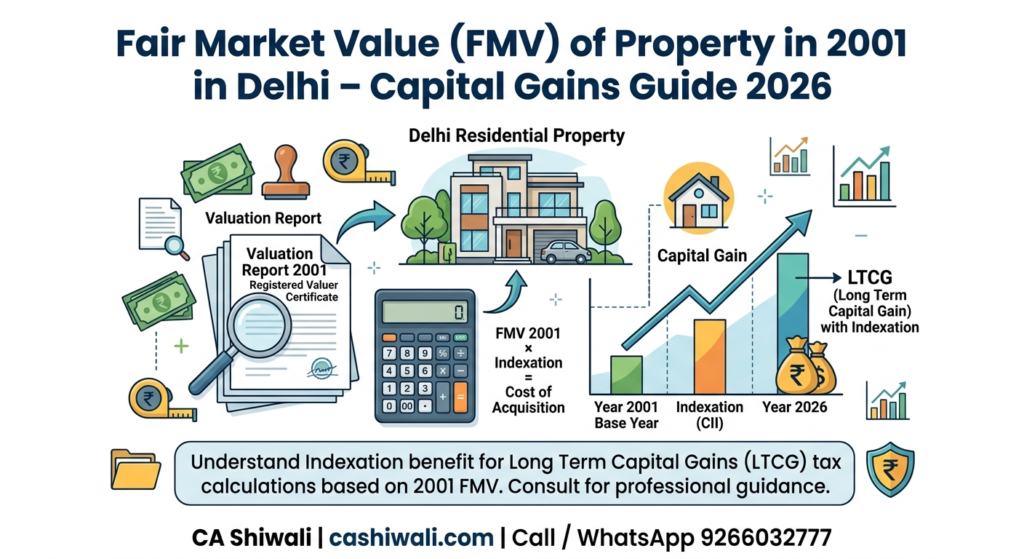
If you are selling a property in Delhi that was purchased before 1 April 2001, determining the Fair Market Value (FMV) as on 1 April 2001 is an important step in calculating capital gains tax.
The Income Tax Act allows property owners to substitute the FMV as on 1 April 2001 instead of the original purchase price when calculating capital gains. This rule can significantly reduce taxable gains, especially for properties that were purchased decades ago.
For property owners in Delhi, determining FMV requires understanding local factors such as historical property values, colony categories, and comparable property sales.
This guide explains how the FMV of property in Delhi as on 1 April 2001 can be determined and how it affects capital gains tax.
Need Help Calculating Capital Gains?
Property tax calculations can become complicated, especially when dealing with older properties, FMV valuation, or exemption claims. CA Shiwali assists property owners across India with accurate capital gains planning.
Professional Assistance Includes:
- FMV as on 1 April 2001 calculation
- Capital gains tax planning
- Section 54 / 54F exemption planning
- Capital gains for inherited or gifted property
- NRI property tax advisory
Online consultation available across India for property tax and capital gains matters.
What is Fair Market Value (FMV) for Property?
Fair Market Value (FMV) refers to the price a property would reasonably sell for in the open market between a willing buyer and a willing seller.
For properties acquired before 1 April 2001, the Income Tax Act allows taxpayers to use the FMV as on that date as the cost of acquisition when calculating capital gains.
This rule helps taxpayers avoid paying tax on property appreciation that occurred before 2001.
For a complete explanation of FMV rules, see:
[How to Determine Fair Market Value (FMV) of Property as on 1 April 2001]
Why FMV is Important for Delhi Property Owners
Property prices in Delhi increased significantly after the early 2000s.
If a property was purchased in the 1980s or 1990s, the original purchase price may be extremely low compared to current market values.
Using FMV as on 1 April 2001 can:
• increase the cost of acquisition
• reduce taxable capital gains
• lower overall tax liability
For high-value properties in areas like South Delhi, the difference can be substantial.
Factors Affecting Property Value in Delhi in 2001
Determining FMV in Delhi depends on several factors.
Colony Category
Different colonies in Delhi fall into categories such as:
• Category A colonies
• Category B colonies
• Category C and D colonies
Property values in 2001 varied widely depending on the colony classification.
Type of Property
The FMV may differ depending on whether the property is:
• residential house
• builder floor
• independent plot
• commercial property
Property Size and Location
Important valuation factors include:
• plot size
• built-up area
• road access
• proximity to markets and metro connectivity
Comparable Property Transactions
Registered valuers often estimate FMV using comparable property sales from the same time period.
Example of FMV Calculation for Delhi Property
Example:
A property in South Delhi was purchased in 1998 for ₹7 lakh.
Estimated FMV as on 1 April 2001: ₹25 lakh.
Sale price in 2025: ₹1.5 crore.
Using FMV significantly increases the cost of acquisition, which reduces the taxable capital gain after applying indexation.
Need Help Determining FMV or Calculating Capital Gains?
CA Shiwali assists property owners across India with:
- FMV as on 1 April 2001 calculation
- Capital gains tax planning
- Section 54 / 54F exemption guidance
How FMV of Property is Determined
The FMV as on 1 April 2001 may be determined through:
Registered Valuer Report
A government-approved valuer can estimate the property value as on 1 April 2001 based on market data.
Historical Market Data
Comparable sales and historical market trends can be used to estimate property value.
Circle Rate References
Although circle rates have changed over time, historical rate data may provide guidance for valuation.
Capital Gains Calculation After Determining FMV
Once FMV as on 1 April 2001 is determined, the value can be adjusted using the Cost Inflation Index (CII).
Indexation increases the cost of acquisition to account for inflation.
This often reduces the taxable capital gain significantly.
To understand how indexation works, see:
[Indexed Cost of Acquisition for Property]
Common Mistakes When Determining FMV
Property owners sometimes make mistakes such as:
• using unrealistic property values
• not obtaining a valuation report
• ignoring indexation benefits
• incorrect capital gains calculation
These mistakes may result in tax scrutiny or higher tax liability.
Professional advice can help avoid such issues.
Capital Gains Advisory – South Delhi
Capital gains tax planning is particularly important for:
• high-value property transactions
• inherited property sales
• NRI property sales
• jointly owned properties
For professional guidance on capital gains tax and property valuation, you may consult CA Shiwali, Chartered Accountant in South Delhi.
Call / WhatsApp: 9266032777
Frequently Asked Questions
How is FMV of property in Delhi as on 1 April 2001 determined?
FMV may be determined through a valuation report from a registered valuer or by analyzing comparable property transactions from that period.
Is a registered valuer required?
While not always mandatory, a registered valuer report is often recommended to support the valuation used in capital gains calculation.
Can the Income Tax Department question FMV?
Yes. If the declared FMV appears unreasonable, the assessing officer may refer the case to a valuation officer.
Does FMV apply to inherited property?
Yes. If the original owner acquired the property before 1 April 2001, FMV as on that date may be used for capital gains calculation.
Related Capital Gains Guides
You may also find these guides helpful on CA Shiwali’s Site:
Capital Gains Tax on Property in India
Capital Gains Property Purchased Before 2001
Indexation Benefit on Property
Section 54 & 54F Capital Gains Exemption
Capital Gains on Inherited Property
Capital Gains on Gifted Property
Posted on Google
 Zahid Khan
Trustindex verifies that the original source of the review is Google.
Very good ,smooth functioning and good professional peoplePosted on Google Gautam PandayExcellent Chartered Accountant! They are highly professional, knowledgeable, and always provide accurate guidance. The entire process was smooth and hassle-free. I truly appreciate their prompt support and transparency. Highly recommended for GST, Income Tax, and accounting services.Posted on Google
 road.to.princeVery nice and Co-oprativePosted on Google
 Harish DhullVery professional and answer queries properly.Posted on Google
 Neeraj Ram
Trustindex verifies that the original source of the review is Google.
Shiwali ji is very polite , truthful services provided by her , filings itr as my 1st experience went well. ThanksPosted on Google Kirpal BishtVery good experience, doubts were cleared by Ms Shiwali, and the process was done quickly….Posted on Google
 Shivam SinghThe firm's services are very professional and delivered on time. The team's guidance has been very clear and helpful, which has greatly assisted in managing our financial affairs.Verified by TrustindexTrustindex verified badge is the Universal Symbol of Trust. Only the greatest companies can get the verified badge who has a review score above 4.5, based on customer reviews over the past 12 months. Read more
If you are unsure about the correct FMV or capital gains calculation, professional advice can help avoid mistakes and unnecessary tax liability.
Need Help Calculating Capital Gains?
Property tax calculations can become complicated, especially when dealing with older properties, FMV valuation, or exemption claims. CA Shiwali assists property owners across India with accurate capital gains planning.
Professional Assistance Includes:
- FMV as on 1 April 2001 calculation
- Capital gains tax planning
- Section 54 / 54F exemption planning
- Capital gains for inherited or gifted property
- NRI property tax advisory
Online consultation available across India for property tax and capital gains matters.
Direct Consultation with CA Shiwali Dagar
Expert tax planning and compliance services tailored for NRIs, property owners, and businesses. Get professional clarity on your complex tax matters today.
Strategic Planning
- ✔ Capital Gains (Sec 54/54F)
- ✔ FMV Valuation (Pre-2001)
- ✔ NRI TDS & Form 13
Tax Compliance
- ✔ IT Notice Resolution
- ✔ 15CA & 15CB Certificates
- ✔ GST & Statutory Audits
Start Your Consultation
Whatspp CA Shiwali Now Call CA Shiwali nowProven Results. Online & Offline.