- Our Services
- Capital Gains Tax (Save Tax on Property Sale)
- Save Capital Gains Tax (Section 54 / 54F)
- Section 50C (Stamp Duty Rule)
- CGAS Scheme
- Fair Market Value (FMV) for Capital Gains 2001
- Joint Property Sale Tax
- NRI Taxation (Property & ITR)
- TDS on NRI Property
- NRI Avoid DTAA/ ITR Filing
- Repatriation
- NRI Property Sale Tax
- Income Tax Notice Help ⚡
- Scrutiny Cases
- Income Tax Notice Reply
- GST Notices
- Tax Notice 143
- Calculate Capital Gains Tax (Free Tool)
- Company / LLP Registration
- GST Registration & Filing
- ITR Filing Services
- About CA Shiwali
- Tax Blog/ Guide
- Contact
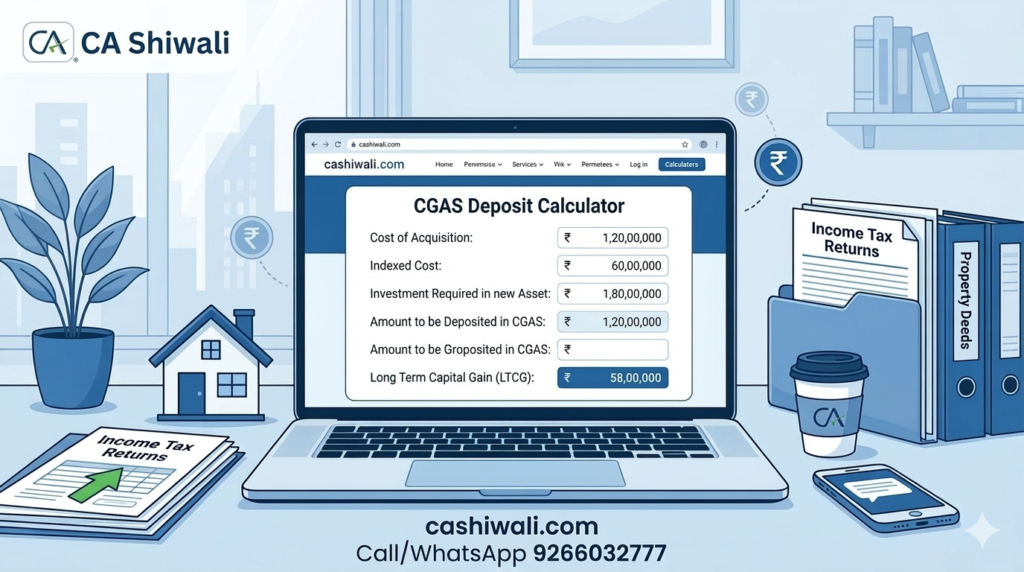
CGAS Deposit Calculator – Calculate Amount to Deposit in Capital Gains Account Scheme
CGAS Deposit Rules for Section 54 and Section 54F
If you sell a property and want to save capital gains tax under Section 54 or Section 54F, you may need to deposit the capital gains amount in the Capital Gains Account Scheme (CGAS).
The CGAS Deposit Calculator by CA Shiwali helps you estimate the amount that should be deposited in the Capital Gains Account Scheme when you cannot immediately invest in another property.
This calculator is useful for:
• Property sellers planning Section 54 exemption
• Taxpayers filing ITR before reinvestment
• Individuals planning capital gains tax saving
Use the calculator below to estimate your CGAS deposit requirement.
📞 CA Shiwali – Chartered Accountant
Call / WhatsApp: 9266032777
🌐 Website: cashiwali.com
CGAS Deposit Calculator
By CA Shiwali | cashiwali.com | Call/WhatsApp 9266032777
Results
Total Capital Gain: ₹ 0
Amount Already Invested: ₹ 0
Recommended CGAS Deposit: ₹ 0
For professional tax planning contact CA Shiwali at 9266032777.
What This Calculator Does
It calculates:
✔ Capital gain from property sale
✔ Amount already invested in new property
✔ Remaining amount that should be deposited in CGAS
This helps taxpayers claim exemption under Section 54
or Section 54F.
Section 54 Capital Gains Exemption
If you are reinvesting the capital gains from a property sale into another residential property, you may claim exemption under Section 54 of the Income Tax Act.
See our complete guide on Section 54 & Section 54F capital gains exemption on property sale to understand eligibility conditions and tax planning strategies.
Example CGAS Calculation
Suppose:
Sale price = ₹80,00,000
Indexed cost = ₹30,00,000
Improvement cost = ₹5,00,000
Expenses = ₹1,00,000
Capital gain:
80,00,000 – 36,00,000
= ₹44,00,000
If you already invested:
₹20,00,000 in a new house
Remaining amount for CGAS deposit:
44,00,000 – 20,00,000
= ₹24,00,000
Important CGAS Rules (India)
Capital Gains Account Scheme allows taxpayers to temporarily deposit capital gains until they purchase or construct another property.
Key rules:
• Deposit must be made before filing income tax return
• Funds must be used within 2 or 3 years depending on the exemption section
• Deposit can be made in authorized banks
FAQs
What is CGAS?
Capital Gains Account Scheme is a government scheme that allows taxpayers to deposit capital gains temporarily to claim exemption under Section 54 or Section 54F.
When should CGAS deposit be made?
The deposit should be made before the due date of filing the income tax return.
Which banks offer CGAS accounts?
Most major banks such as SBI, Bank of Baroda, Punjab National Bank and Canara Bank provide CGAS accounts.
Can CGAS money be withdrawn?
Yes, but withdrawal must be used only for purchase or construction of property.
Read more .
• Capital gains tax on property
• Section 50C
• Capital gains on gifted property
• Lower TDS certificate for NRI sale
• CGAS guide page.
📞 CA Shiwali – Chartered Accountant
Call / WhatsApp: 9266032777
🌐 Website: cashiwali.com
Posted on Google
 Zahid Khan
Trustindex verifies that the original source of the review is Google.
Very good ,smooth functioning and good professional peoplePosted on Google Gautam PandayExcellent Chartered Accountant! They are highly professional, knowledgeable, and always provide accurate guidance. The entire process was smooth and hassle-free. I truly appreciate their prompt support and transparency. Highly recommended for GST, Income Tax, and accounting services.Posted on Google
 road.to.princeVery nice and Co-oprativePosted on Google
 Harish DhullVery professional and answer queries properly.Posted on Google
 Neeraj Ram
Trustindex verifies that the original source of the review is Google.
Shiwali ji is very polite , truthful services provided by her , filings itr as my 1st experience went well. ThanksPosted on Google Kirpal BishtVery good experience, doubts were cleared by Ms Shiwali, and the process was done quickly….Posted on Google
 Shivam SinghThe firm's services are very professional and delivered on time. The team's guidance has been very clear and helpful, which has greatly assisted in managing our financial affairs.Verified by TrustindexTrustindex verified badge is the Universal Symbol of Trust. Only the greatest companies can get the verified badge who has a review score above 4.5, based on customer reviews over the past 12 months. Read more
Expert Financial Advisory
Expert Tax Planning for Your Property Sale
Secure your gains. Minimize your liability with professional intervention from CA Shiwali & Co.
★ Verified Accuracy
Precise indexation & capital gains math.
🛡️ Notice Protection
Professional handling of IT Department inquiries.
🌍 NRI Specialist
TDS & compliance for international sellers.
Ready to file correctly? Connect now:
Direct Consultation with CA Shiwali Dagar
Expert tax planning and compliance services tailored for NRIs, property owners, and businesses. Get professional clarity on your complex tax matters today.
Strategic Planning
- ✔ Capital Gains (Sec 54/54F)
- ✔ FMV Valuation (Pre-2001)
- ✔ NRI TDS & Form 13
Tax Compliance
- ✔ IT Notice Resolution
- ✔ 15CA & 15CB Certificates
- ✔ GST & Statutory Audits
Start Your Consultation
Whatspp CA Shiwali Now Call CA Shiwali nowProven Results. Online & Offline.