Union Budget 2026: What Changed for Salaried, Self-Employed & Small Business Owners?
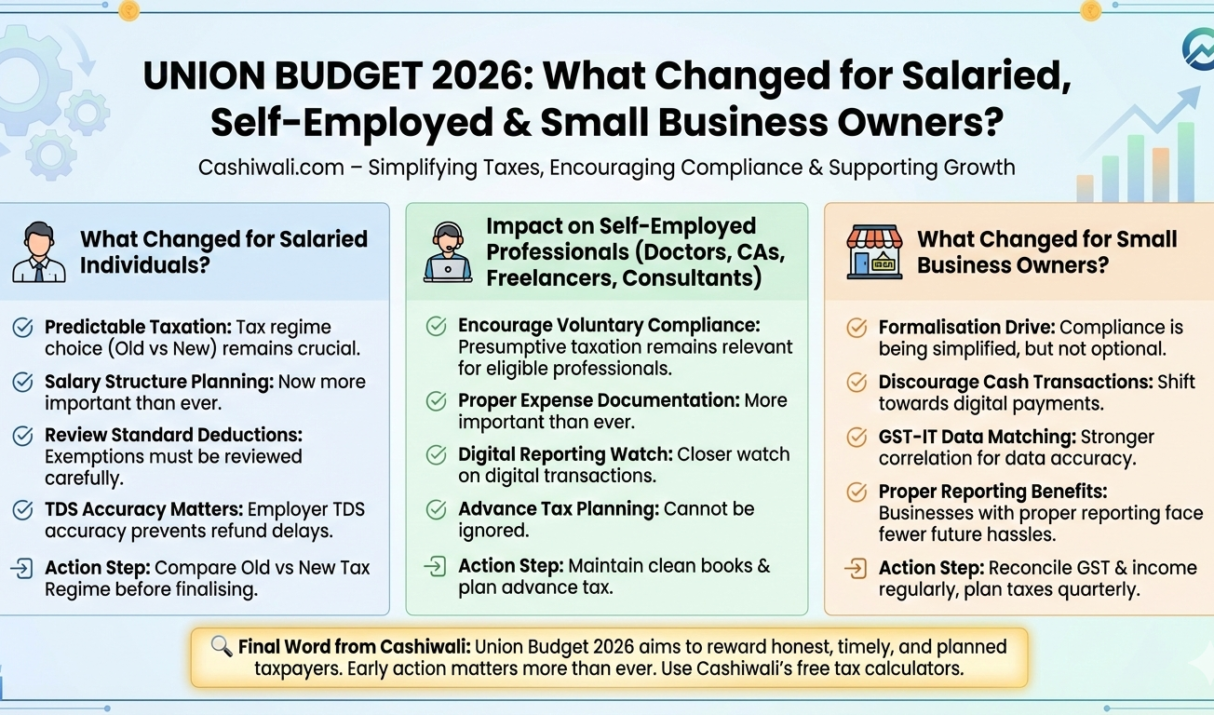
Union Budget 2026 has introduced several important changes impacting salaried employees, self-employed professionals, and small business owners in India. While the government’s focus remains on simplification, compliance, and middle-class relief, the actual benefit depends on how your income is structured.
In this detailed guide, Cashiwali explains:
Budget 2026 tax changes in simple language
Impact on salaried individuals, professionals, and businesses
What taxpayers should do after Budget 2026
🔎 Union Budget 2026 Highlights (Quick Summary)
Continued emphasis on simplified income tax compliance
Strong push towards digital reporting and transparency
Measures aimed at middle-income taxpayers
Increased data matching between GST, banks, and Income Tax
Encouragement for early and accurate tax planning
⚠️ Note: Budget benefits vary by income level and tax regime selection.
👔 Union Budget 2026 Impact on Salaried Employees
Salaried taxpayers remain a key focus area in Budget 2026, especially those earning in the middle-income bracket.
Key Changes & Considerations:
Choosing between Old vs New Tax Regime remains critical
Salary structuring plays a major role in tax savings
Accurate TDS deduction by employer is more important than ever
Mismatch between Form 16, AIS & TIS can delay refunds
What Salaried Taxpayers Should Do After Budget 2026:
Review salary components and exemptions
Compare tax liability under both regimes before finalising
Verify Form 16 with AIS
Start tax planning early instead of waiting till March
🧑💻 Budget 2026 Impact on Self-Employed Professionals
(Self-employed professionals include doctors, CAs, freelancers, consultants, architects, and designers.)
What Budget 2026 Signals for Professionals:
Presumptive taxation continues to be relevant where applicable
Expense documentation is under increased scrutiny
Digital income reporting is closely monitored
Advance tax compliance is non-negotiable
Recommended Actions:
Maintain clean records even under presumptive schemes
Track income and expenses monthly
Pay advance tax on time to avoid interest
Review whether presumptive taxation is still beneficial
🏪 Union Budget 2026 Impact on Small Business Owners
Small and medium businesses are central to the government’s formal economy push.
Key Observations:
Compliance is simpler, but enforcement is stricter
Cash transactions are discouraged
GST returns and income tax filings are increasingly linked
Proper reporting reduces future notices and penalties
What Small Businesses Should Do:
Regularly reconcile GST and income tax data
Avoid under-reporting turnover
Keep bank statements and books aligned
Plan taxes quarterly instead of annually
⚖️ Old vs New Tax Regime After Budget 2026: Which Is Better?
Budget 2026 does not declare one tax regime as universally better.
General Guidance:
Taxpayers with deductions may benefit from the Old Regime
Those with fewer exemptions may prefer the New Regime
Professionals and business owners must calculate carefully
👉 Choosing the wrong regime can increase your tax liability.
❌ Common Tax Mistakes After Budget 2026
Selecting a tax regime without calculation
Ignoring advance tax obligations
Assuming “no major change” means no action required
Waiting till the end of the financial year for planning
✅ What Should Taxpayers Do After Union Budget 2026?
Budget announcements alone do not reduce tax—planning does.
Smart Next Steps:
Use Cashiwali’s free income tax calculators
Review tax liability early in the financial year
Align income, deductions, and compliance
Seek professional advice where required
📌 Final Thoughts: Budget 2026 & You
Union Budget 2026 continues the shift towards a transparent, compliant, and predictable tax system.
Taxpayers who plan early, report accurately, and choose the right tax regime will benefit the most.
Whether you are salaried, self-employed, or a business owner—Budget 2026 rewards preparedness.
Frequently Asked Questions (FAQs) – Union Budget 2026
1. What are the major tax changes in Union Budget 2026?
Union Budget 2026 focuses on simplifying tax compliance, encouraging digital reporting, and providing relief-oriented measures for middle-income taxpayers. The actual impact depends on income type and tax regime selection.
2. Does Union Budget 2026 change income tax slabs?
Budget 2026 does not introduce a one-size-fits-all change. Tax slabs and benefits must be evaluated under both the old and new tax regimes to determine which is more beneficial for an individual taxpayer.
3. Which tax regime is better after Budget 2026 – old or new?
There is no universal answer. Taxpayers with deductions and exemptions may benefit from the old tax regime, while those with simpler income structures may find the new tax regime more suitable.
4. How does Budget 2026 impact salaried employees?
Salaried employees should focus on salary structuring, accurate TDS deductions, and matching Form 16 with AIS and TIS to avoid refund delays and compliance issues.
5. What should self-employed professionals do after Budget 2026?
Self-employed professionals should maintain proper records, track expenses regularly, plan advance tax payments, and review whether presumptive taxation is still beneficial.
6. Are small business owners affected by Union Budget 2026?
Yes. Small businesses are encouraged to remain compliant through simplified processes, increased data matching, and reduced reliance on cash transactions.
7. Is advance tax mandatory after Budget 2026?
Advance tax rules continue to apply. Salaried individuals with additional income, professionals, and business owners must pay advance tax to avoid interest and penalties.
8. What is the biggest mistake taxpayers make after the budget?
The most common mistake is assuming the budget does not affect them and delaying tax planning until the end of the financial year.