
phone
+91-9266032777
email
CaShiwalidagar@gmail.com
Section 54F Exemption Calculator (India)
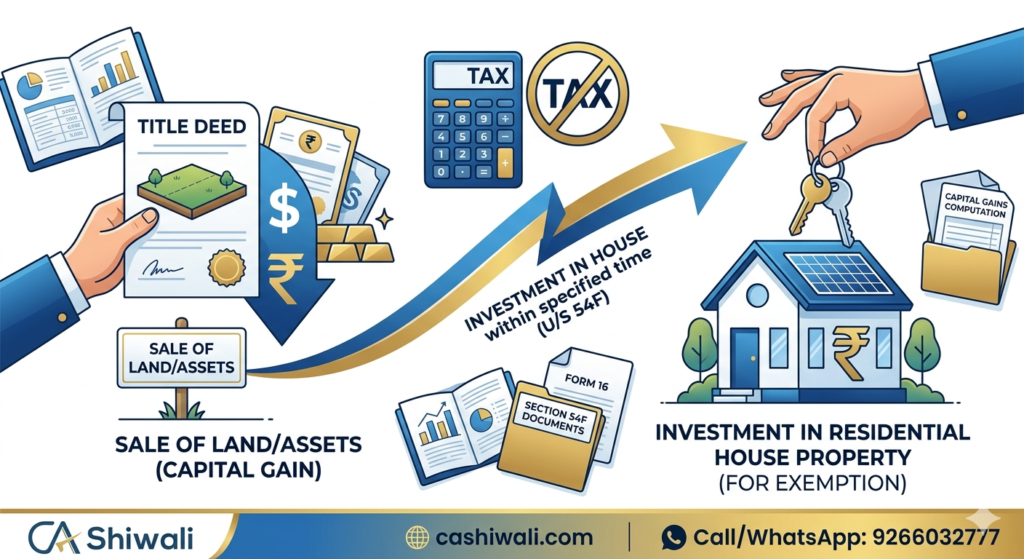
Calculate Capital Gains Exemption Under Section 54F
The Section 54F of the Income Tax Act allows taxpayers to claim exemption from long-term capital gains tax when they sell assets such as plot, land, shares, or gold and invest the sale proceeds in a residential house property.
Use the calculator below to estimate the exemption available under Section 54F.
Section 54F Exemption Calculator
What is Section 54F Exemption?
Section 54F of the Income Tax Act provides a valuable tax benefit for individuals and Hindu Undivided Families (HUFs) who earn long-term capital gains from the sale of assets other than a residential house.
Under this section, if a taxpayer sells assets such as plot of land, commercial property, shares, mutual funds, or gold, they may claim exemption from capital gains tax by investing the sale proceeds into a new residential house property in India.
The objective of Section 54F is to encourage taxpayers to invest in residential housing while reducing their capital gains tax burden. If the conditions under this section are satisfied, the taxpayer can either partially or fully eliminate the tax liability arising from the sale of the asset.
The exemption is calculated based on the proportion of the investment in the new house compared to the total net sale consideration received from the sale of the original asset.
Difference Between Section 54 and Section 54F
Many taxpayers confuse Section 54 and Section 54F, but they apply in different situations.
Section 54 applies when a taxpayer sells a residential house property and reinvests the capital gain in another residential house.
Section 54F applies when a taxpayer sells any long-term capital asset other than a residential house, such as land, gold, or shares, and invests the sale proceeds into a residential house.
In simple terms:
Section 54: Sale of house → buy another house
Section 54F: Sale of other asset → buy a house
Understanding this difference is important when planning capital gains tax savings.
How Section 54F Exemption is Calculated
The exemption under Section 54F is calculated using the following formula:
Exemption = Capital Gain × (Investment in New House ÷ Net Sale Consideration)
This means the exemption depends on how much of the sale proceeds are invested in the new residential property.
If the entire sale consideration is invested in the new house, the entire capital gain may become exempt from tax. However, if only part of the sale proceeds are invested, the exemption will be proportionately reduced.
Example of Section 54F Capital Gains Calculation
Consider the following example to understand how Section 54F works.
Suppose a taxpayer sells a plot of land and receives the following:
Net sale consideration: ₹80,00,000
Indexed cost of acquisition: ₹40,00,000
Capital gain: ₹40,00,000
Now suppose the taxpayer invests ₹60,00,000 in purchasing a new residential house.
Using the Section 54F formula:
Exemption = 40,00,000 × (60,00,000 ÷ 80,00,000)
Exemption = ₹30,00,000
Taxable capital gain = ₹10,00,000
If the taxpayer had invested the entire ₹80,00,000 in the new property, then the entire capital gain of ₹40,00,000 could have been exempt from tax.
Conditions to Claim Section 54F Exemption
To claim exemption under Section 54F, the following conditions must be satisfied:
The capital asset sold must be a long-term capital asset other than a residential house.
The taxpayer must purchase or construct one residential house property in India.
The taxpayer should not own more than one residential house property on the date of transfer of the original asset, other than the new property being purchased.
The taxpayer should not purchase another residential house within two years after the sale of the asset.
The taxpayer should not construct another residential house within three years after the sale.
If any of these conditions are violated, the exemption claimed earlier may become taxable.
Time Limit for Investment in New Residential Property
Section 54F provides specific time limits for investing the sale proceeds into a new house.
The taxpayer can:
Purchase a house within 1 year before the sale, or
Purchase a house within 2 years after the sale, or
Construct a house within 3 years after the sale
These time limits are strictly monitored by the Income Tax Department when assessing eligibility for exemption.
If the investment is not completed before filing the income tax return, the taxpayer may deposit the amount under the Capital Gains Account Scheme. This scheme allows taxpayers to temporarily park the capital gains amount until it is utilized for purchasing or constructing the new property.
Situations Where Section 54F Exemption May Not Be Allowed
There are certain situations where taxpayers may not be eligible to claim exemption under Section 54F.
For example:
If the taxpayer already owns more than one residential house at the time of selling the asset.
If the investment in the new property is made outside India.
If the new residential property is sold within three years of purchase or construction.
If the taxpayer purchases another house within the restricted time period.
In such cases, the exemption previously claimed may be withdrawn and the capital gain will become taxable.
Importance of Proper Capital Gains Planning
Capital gains tax can significantly reduce the profit earned from selling assets such as land, shares, or gold. However, proper tax planning using provisions like Section 54F can help taxpayers legally reduce their tax liability.
Before selling a capital asset, it is advisable to understand:
the expected capital gain,
the tax rate applicable,
the available exemptions, and
the investment timeline required to claim those exemptions.
Using tools such as a Section 54F Exemption Calculator can help estimate the potential tax savings and assist taxpayers in making informed investment decisions.
Frequently Asked Questions (FAQs) – Section 54F
What is Section 54F exemption in income tax?
Section 54F of the Income Tax Act allows individuals and Hindu Undivided Families (HUFs) to claim exemption from long-term capital gains tax when they sell assets such as land, shares, gold, or mutual funds and invest the sale proceeds in a residential house property in India.
If the conditions under this section are satisfied, the capital gain may become partially or fully exempt from tax.
How is Section 54F exemption calculated?
The exemption is calculated using the following formula:
Exemption = Capital Gain × (Investment in New House ÷ Net Sale Consideration)
If the entire sale consideration is invested in the new residential property, the full capital gain may be exempt from tax.
What assets qualify for Section 54F exemption?
Section 54F applies when the taxpayer sells long-term capital assets other than residential house property, such as:
Plot or land
Commercial property
Shares or mutual funds
Gold or jewellery
If the taxpayer sells a residential house instead, the exemption usually falls under Section 54 of the Income Tax Act.
What is the time limit to invest under Section 54F?
To claim exemption under Section 54F, the taxpayer must invest the sale proceeds within the following time limits:
Buy a new house 1 year before the sale, or
Buy a new house within 2 years after the sale, or
Construct a new house within 3 years after the sale
If the investment is not completed before filing the income tax return, the funds can be deposited in the Capital Gains Account Scheme (CGAS).
Can Section 54F exemption be claimed for more than one house?
Generally, Section 54F allows exemption only when the investment is made in one residential house property in India.
However, under certain conditions introduced in recent tax provisions, taxpayers may claim exemption for two residential houses if the capital gains do not exceed ₹2 crore, but this option can usually be exercised only once in a lifetime.
Can Section 54F exemption be claimed if I already own a house?
Section 54F exemption may not be available if the taxpayer owns more than one residential house on the date of transfer of the original asset, other than the new house being purchased.
Therefore, eligibility depends on the number of residential properties already owned.
What happens if the new house is sold within three years?
If the new residential property purchased under Section 54F is sold within three years, the exemption claimed earlier may be withdrawn.
In such cases, the exempted capital gain will become taxable in the year in which the new house is sold.
Is Section 54F applicable to short-term capital gains?
No. Section 54F applies only to long-term capital gains. If the asset sold is classified as a short-term capital asset, the exemption under this section cannot be claimed.
How can a Section 54F calculator help?
A Section 54F calculator helps taxpayers quickly estimate:
Eligible exemption amount
Taxable capital gain
Potential tax savings
Using a calculator makes it easier to plan property investments and understand the tax impact before filing the income tax return.
Need Professional Help for Capital Gains Tax?
Capital gains taxation can sometimes be complex, especially when multiple assets, exemptions, and timelines are involved. Professional guidance can help ensure that taxpayers comply with the law while minimizing their tax liability.
If you need assistance with capital gains tax planning, property sale taxation, or Section 54F exemption, you can consult a qualified tax professional.
Related Capital Gains Calculators
CA Shiwali
Chartered Accountant – Tax Advisory & Capital Gains Consultation
🌐 cashiwali.com
📞 Call / WhatsApp: 9266032777
