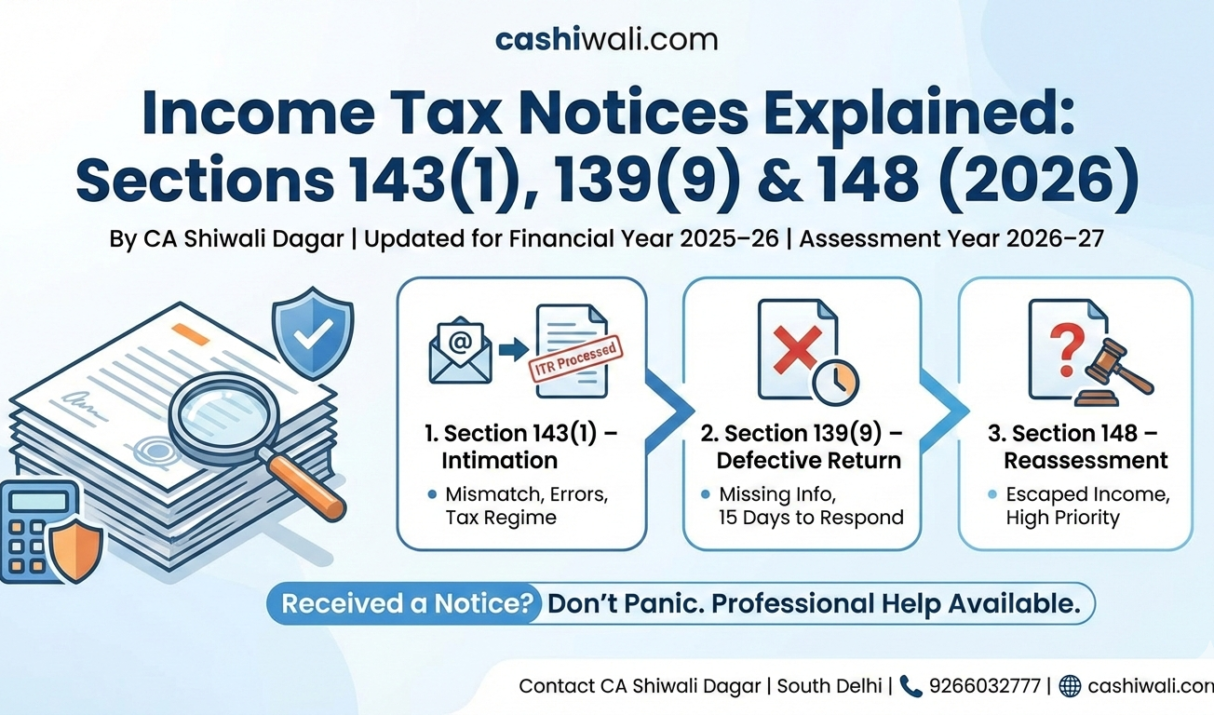
Income Tax Notices Explained: Sections 143(1), 139(9) & 148 (2026)
Author: CA Shiwali Dagar
Updated for: Financial Year 2025–26 | Assessment Year 2026–27
Received an Income Tax Notice? Don’t Panic.
Receiving an Income Tax Notice from the Income Tax Department can be stressful—but most notices are informational or rectifiable if handled correctly and on time.
This guide explains the three most common income tax notices received by taxpayers in India:
Section 143(1) – Intimation after return processing
Section 139(9) – Defective return notice
Section 148 – Reassessment notice
Understanding the difference is crucial to avoid unnecessary tax demands, penalties, or litigation.
1️⃣ Income Tax Notice Under Section 143(1)
What is Section 143(1)?
Section 143(1) is an intimation, not a scrutiny. It is issued after your Income Tax Return (ITR) is processed by the CPC (Centralised Processing Centre).
Common Reasons for 143(1) Notice
Mismatch between ITR and Form 26AS / AIS
Incorrect TDS credit claim
Arithmetical errors in return
Incorrect tax regime selection
Late filing fee adjustment under Section 234F
What You Should Do
Compare notice with your filed ITR
Check AIS, TIS, and Form 26AS
File rectification (Section 154) if error is from department side
Pay demand only after verification
⚠️ Ignoring a 143(1) notice can convert a small mismatch into a permanent tax demand.
2️⃣ Income Tax Notice Under Section 139(9)
What is a Section 139(9) Notice?
This notice means your return is considered defective due to missing or incorrect information.
Common Defects Under 139(9)
Balance Sheet & P&L not uploaded for business returns
Incorrect ITR form selection
Missing audit details (where applicable)
Income mismatch with schedules
Mandatory schedules left blank
Time Limit to Respond
Consequences of Non-Response
If not corrected:
3️⃣ Income Tax Notice Under Section 148 (Reassessment)
What is Section 148?
A notice under Section 148 is issued when the Assessing Officer believes that income has escaped assessment.
This is a serious notice and must never be ignored.
Common Triggers for Section 148
High-value transactions
Undisclosed bank accounts
Property or share sale mismatch
Information received from third parties
Incorrect capital gains reporting
New Reassessment Framework (Post 2021)
Prior notice under Section 148A
Opportunity of being heard
Speaking order before reassessment
Why Professional Handling Is Critical
Comparison of Income Tax Notices
| Section | Nature | Seriousness | Action Required |
|---|
| 143(1) | Intimation | Low–Medium | Verify & rectify |
| 139(9) | Defective Return | Medium | Correct within deadline |
| 148 | Reassessment | High | CA-assisted response |
How CA Shiwali Dagar Helps with Tax Notices
✔ Detailed notice analysis
✔ AIS / TIS reconciliation
✔ Rectification & reply drafting
✔ Representation before tax authorities
✔ Litigation support when required
All notices are handled with accuracy, documentation discipline, and legal clarity.
Frequently Asked Questions
Is a 143(1) notice bad?
No. It is usually a routine intimation. However, it must be checked carefully.
Can I reply to a tax notice myself?
Simple notices may be handled personally, but professional review is strongly recommended to avoid mistakes.
What happens if I ignore an income tax notice?
Ignoring notices can lead to penalties, interest, best judgment assessment, or recovery proceedings.
Contact CA Shiwali Dagar for Income Tax Notice Help
📍 South Delhi
📞 Phone: 9266032777
🌐 Website: https://cashiwali.com
Final Advice
An income tax notice is not a punishment—it is a request for clarification. Responding correctly and on time protects your finances and peace of mind.
If in doubt, consult a professional.
Related Reads:
Income Tax Notice Assistance
Section 143(1) Intimation Explained
Reassessment Under Section 148 (New Law)