phone
+91-9266032777
email
CaShiwalidagar@gmail.com

How to Pay Zero Tax in India Legally (Complete Guide for 2025)
By Cashiwali.com – India’s Trusted Tax & Compliance Partner
Paying taxes is a responsibility, but paying more tax than required is not!
Most Indians don’t know that the Income Tax Act provides several legal ways to reduce taxable income — many of which can even bring your final tax payable to zero.
This guide simplifies all the methods you can use to reduce your tax burden 100% legally.
⚠️ Important Note
Tax-saving should always follow legal provisions, not shortcuts. The techniques below are government-approved and safe for salaried individuals, business owners, and professionals.
1. Use Section 80C Fully – Save Up to ₹1,50,000
One of the easiest ways to reduce taxes is by using deductions under Section 80C.
Eligible options include:
ELSS Mutual Funds
Provident Fund (PF / VPF)
Life Insurance Premium
Principal repayment of Home Loan
Children’s Tuition Fees
Public Provident Fund (PPF)
5-Year Tax Saving FD
Most salaried people already have PF deducted, so with a few additional investments, they can reach the full ₹1.5 lakh deduction.
2. Use Section 80D – Health Insurance Deductions
You can reduce taxable income further by:
₹25,000 for health insurance of self, spouse, and children
₹25,000–₹50,000 for parents’ health insurance
This can save a big tax amount while giving financial protection.
3. Claim House Rent Allowance (HRA)
If you live in a rented house and receive HRA as part of your salary, you can reduce taxable salary by claiming HRA exemption.
Even if you pay rent to your parents, it can be valid with proper rent receipts and their PAN number.
4. Home Loan Interest – Section 24(b)
If you have a home loan, the interest portion gives a deduction up to:
₹2,00,000 per year (for self-occupied house)
This major deduction can bring many salaried individuals to zero tax liability.
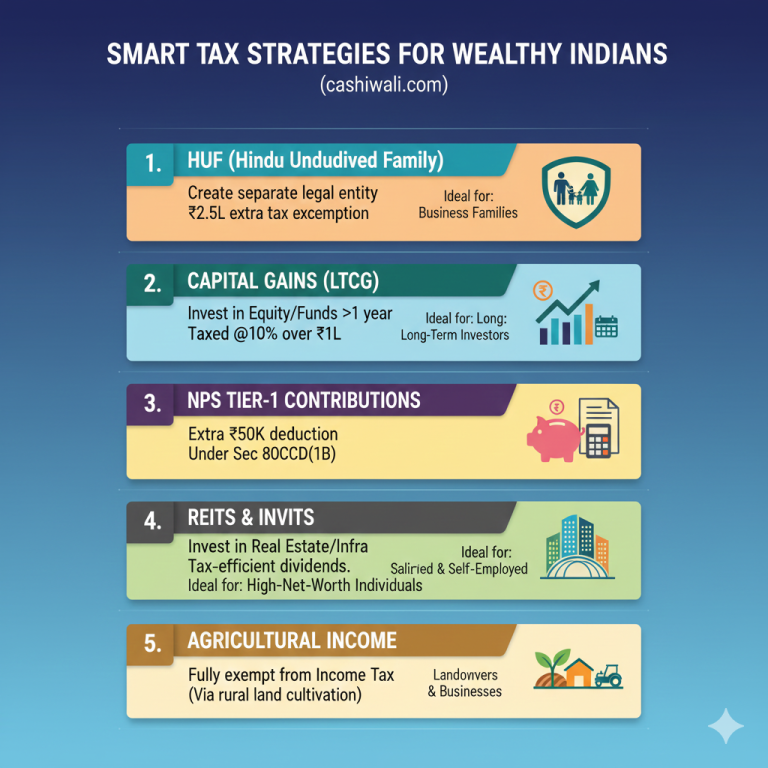
5. National Pension Scheme (NPS) – Extra ₹50,000 Deduction
Apart from 80C, you get an additional deduction of ₹50,000 under Section 80CCD(1B).
This is a powerful way to reduce taxes for high-salary earners.
6. Standard Deduction for Salaried Individuals
Every salaried person automatically gets:
₹50,000 Standard Deduction
This directly reduces taxable salary without needing any proof or investment.
7. Business Owners & Freelancers – Expense Deductions
If you run a business or work as a freelancer, you can reduce tax legally by claiming business expenses like:
Mobile & Internet bills
Work-related travel
Rent for office space
Laptop, printer, software
Marketing & advertising expenses
Professional fees
Only net profit after expenses is taxed.
Many freelancers bring their income near zero legally using proper deductions.
8. Choose the Right Tax Regime (Old vs New)
The government now allows two options:
Old Tax Regime
More deductions
Best for people who invest & claim exemptions
New Tax Regime
Lower tax slabs
Best for people who don’t invest much
Choosing the right regime can reduce your tax to almost zero depending on your salary structure.
9. Agricultural Income is Tax-Free
If you earn income from agricultural land, it is 100% tax-free (with some conditions).
Many taxpayers with agriculture background use this to reduce overall tax burden legally.
10. Rebate for Income Up to ₹7 Lakh (New Regime)
Under the new regime, individuals with income up to a certain limit are eligible for full tax rebate, meaning final tax is zero after rebate.
✔️ Example: Paying Zero Tax Legally
A salaried employee earning ₹9–12 lakhs per year can reduce their taxable income using:
80C: ₹1,50,000
80D: ₹25,000–₹50,000
HRA exemption
Home loan interest deduction
NPS: ₹50,000
Standard deduction: ₹50,000
With these, many individuals legally bring their taxable income close to zero.
Conclusion
Paying zero tax in India is absolutely possible — and 100% legal — if you use the tax-saving options provided under the Income Tax Act.
However, tax planning must be done correctly, otherwise incorrect claims can lead to penalty or notice.
Need Help Reducing Your Tax to Zero?
At Cashiwali.com, we help individuals and businesses with:
Tax Planning
GST Returns
Income Tax Returns
Assessments & Notices
Company & Trust Registration
Get expert support and pay the lowest tax legally.
👉 Contact Cashiwali today for a free initial consultation.
Direct Consultation with CA Shiwali Dagar
Expert tax planning and compliance services tailored for NRIs, property owners, and businesses. Get professional clarity on your complex tax matters today.
Strategic Planning
- ✔ Capital Gains (Sec 54/54F)
- ✔ FMV Valuation (Pre-2001)
- ✔ NRI TDS & Form 13
Tax Compliance
- ✔ IT Notice Resolution
- ✔ 15CA & 15CB Certificates
- ✔ GST & Statutory Audits
Start Your Consultation
Whatspp CA Shiwali Now Call CA Shiwali nowProven Results. Online & Offline.