phone
+91-9266032777
email
CaShiwalidagar@gmail.com
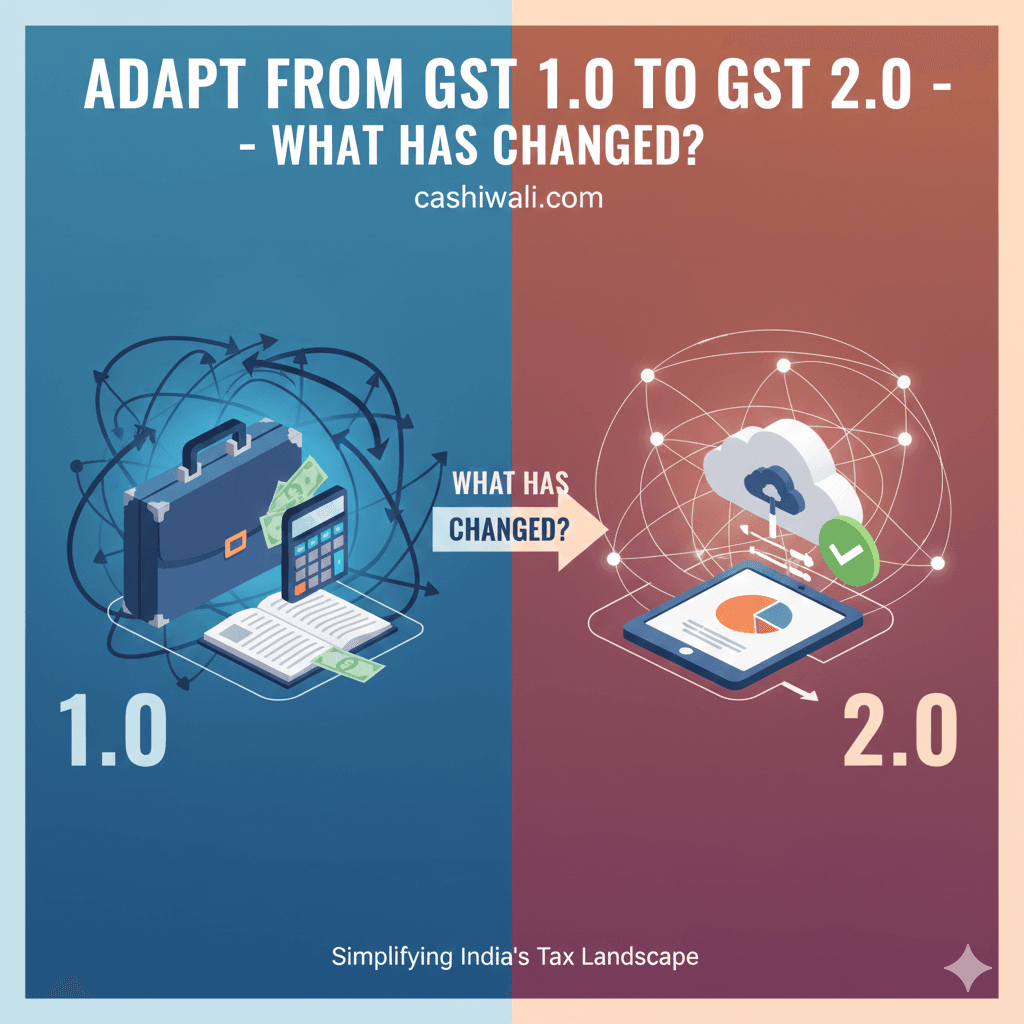
How to Adapt From GST 1.0 to GST 2.0: What Changed & What Businesses Must Do in 2025
India’s GST system is evolving. After years of using GST 1.0, the government has begun rolling out features of a more advanced, technology-driven system — popularly referred to as GST 2.0.
GST 2.0 is not a new tax, but an upgraded framework designed to simplify compliance, reduce fraud, and automate reconciliations.
This article explains:
✔️ What GST 2.0 means
✔️ Key differences between GST 1.0 and GST 2.0
✔️ What businesses must do to prepare
✔️ How to adapt smoothly
✔️ Why professional support matters
What is GST 2.0?
GST 2.0 is an improved GST return and compliance system that focuses on:
Automatic invoice matching
Real-time input tax credit (ITC) updates
AI-driven fraud detection
Seamless supplier–buyer reconciliation
Better reporting and analytics
It aims to reduce manual work and ensure more accurate tax compliance.
GST 1.0 vs GST 2.0 — What Has Changed?
Here are the major changes businesses will experience:
1. Input Tax Credit (ITC) Will Be Fully Auto-Generated
GST 1.0:
Businesses manually calculated eligible ITC based on GSTR-2A/2B, often leading to mismatches.
GST 2.0:
ITC will be generated automatically based on supplier uploads.
If the supplier doesn’t upload invoices, ITC won’t reflect.
✔️ Impact: Stronger need to work only with compliant suppliers.
2. GSTR-1 and GSTR-3B Will Be Auto-Linked
GST 1.0:
GSTR-3B was manually prepared, allowing errors and mismatches.
GST 2.0:
GSTR-3B will be auto-populated from GSTR-1 and e-invoices.
✔️ Impact: Less manual entry, fewer notices.
3. Supplier–Buyer Invoice Matching Becomes Mandatory
GST 1.0:
Invoice matching was recommended but not fully enforced.
GST 2.0:
Invoice matching becomes core, ensuring both sides report the same details.
✔️ Impact: Businesses must reconcile monthly to avoid ITC loss.
4. Stricter ITC Claim Rules
Under GST 2.0:
ITC allowed only when vendor uploads invoice
Provisional ITC will be eliminated
Real-time blocking of suspicious ITC claims
✔️ Impact: Businesses must actively monitor vendor compliance.
5. More Dependence on E-Invoices & E-Way Bills
GST 2.0 integrates:
E-Invoices
E-Way bills
GSTR-1
GSTR-3B
All systems talk to each other automatically.
✔️ Impact: Any mismatch triggers automated alerts and notices.
6. AI-Based Compliance Rating
The government is moving towards a GST Compliance Score for every taxpayer.
High score = smooth ITC, fewer notices
Low score = blocked ITC, more scrutiny
✔️ Impact: Maintaining clean records becomes essential.
How to Adapt Smoothly from GST 1.0 to GST 2.0
To stay compliant, follow these steps:
1. Strengthen Vendor Management
Work only with compliant GST suppliers
Regularly verify if they file GSTR-1 on time
Use automated reminders & follow-ups
Reason: Your ITC depends on their compliance.
2. Switch to E-Invoice Compatible Software
GST 2.0 requires seamless syncing of:
Invoices
E-way bills
GSTR filings
Use software that integrates all these automatically.
3. Perform Monthly Reconciliation (Not Yearly)
In GST 2.0, reconciliation should be done every month to avoid:
ITC loss
Late fees
Possible notices
4. Maintain Clean Books of Accounts
Ensure:
GSTIN is correct on every invoice
HSN codes are accurate
Tax rates are correctly applied
Credit notes & debit notes are timely issued
5. File GSTR-1 and GSTR-3B on Time, Every Time
Since 2.0 auto-links these returns, late filing affects both you and your customers.
6. Train Your Finance & Accounts Team
Your team must understand:
Auto-populated returns
ITC restrictions
Invoice matching rules
E-invoicing updates
Training avoids costly mistakes.
Benefits of GST 2.0 for Businesses
Despite being stricter, GST 2.0 helps businesses:
Reduce mismatches and errors
Save time on reconciliation
Avoid penalties and notices
Improve ITC accuracy
Strengthen financial discipline
Conclusion
GST 2.0 brings a major shift from manual reporting to fully automated, data-driven compliance.
Businesses that prepare early will avoid disruptions and maintain seamless input tax credit flow.
If you want help adapting to GST 2.0, Cashiwali.com can assist you with:
GST return filing
GST reconciliation
Notice handling
Accounting & compliance
End-to-end GST automation
Stay compliant. Stay stress-free. Choose Cashiwali.
Direct Consultation with CA Shiwali Dagar
Expert tax planning and compliance services tailored for NRIs, property owners, and businesses. Get professional clarity on your complex tax matters today.
Strategic Planning
- ✔ Capital Gains (Sec 54/54F)
- ✔ FMV Valuation (Pre-2001)
- ✔ NRI TDS & Form 13
Tax Compliance
- ✔ IT Notice Resolution
- ✔ 15CA & 15CB Certificates
- ✔ GST & Statutory Audits
Start Your Consultation
Whatspp CA Shiwali Now Call CA Shiwali nowProven Results. Online & Offline.