phone
+91-9266032777
email
CaShiwalidagar@gmail.com
Capital Gains Tax on Property for NRIs in India (2026)
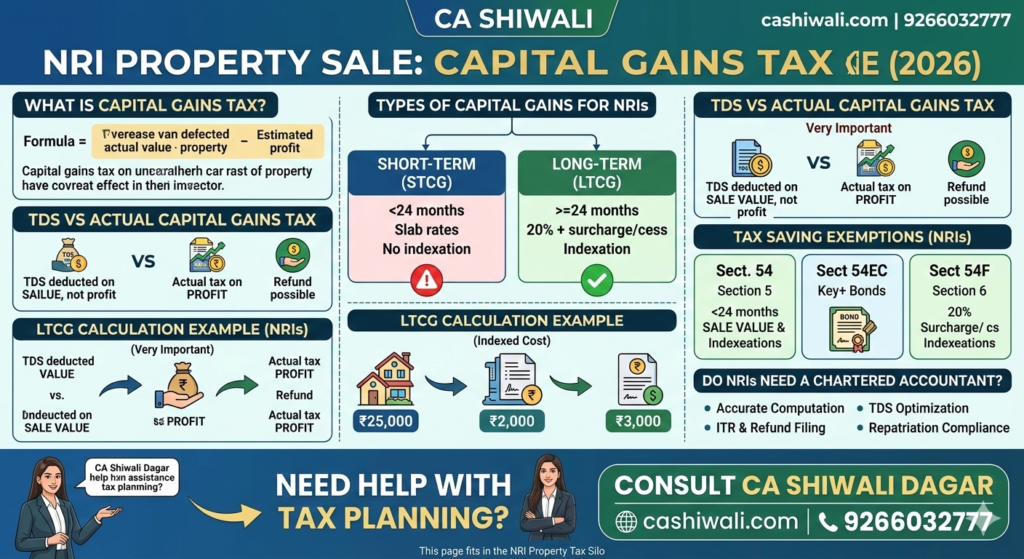
Capital Gains Tax on Property for NRIs in India (2026)
Non-Resident Indians (NRIs) selling property in India are subject to capital gains tax, just like resident Indians. However, the tax rates, TDS rules, exemptions, and compliance requirements for NRIs are different and often misunderstood.
This page explains capital gains tax on property for NRIs in simple terms — when it applies, how it is calculated, and how NRIs can legally reduce or plan their tax liability in India.
What Is Capital Gains Tax on Property?
Capital gains tax is the tax payable on the profit earned from selling a property.
Capital Gain = Sale Price – (Purchase Cost + Allowed Expenses)
For NRIs, capital gains tax applies whether:
The sale proceeds remain in India, or
The money is repatriated abroad
Types of Capital Gains for NRIs
Capital gains are classified based on the holding period of the property.
Short-Term Capital Gains (STCG)
Holding period: Less than 24 months
Tax rate: As per applicable income tax slab
Indexation benefit: ❌ Not allowed
📌 Short-term capital gains are fully taxable and usually result in higher tax liability.
Long-Term Capital Gains (LTCG)
Holding period: 24 months or more
Tax rate: 20% + surcharge + cess
Indexation benefit: ✅ Allowed
📌 Most NRI property transactions fall under long-term capital gains.
How Is Capital Gains Calculated for NRIs?
For Long-Term Capital Gains:
Purchase price is adjusted using Cost Inflation Index (CII)
This reduces the taxable gain legally
Example (simplified):
Purchase price (indexed): ₹50 lakh
Sale price: ₹80 lakh
Long-term capital gain: ₹30 lakh
Tax @20% = ₹6 lakh (+ cess & surcharge)
TDS vs Actual Capital Gains Tax (Very Important)
Many NRIs believe that TDS deducted by the buyer is the final tax — this is incorrect.
TDS Rules:
20% TDS on LTCG
30% TDS on STCG
TDS is deducted on sale value, not profit
📌 Actual capital gains tax may be lower than TDS deducted.
👉 NRIs can claim refund or apply for lower TDS certificate.
🔗 This is explained in detail on our TDS on Property Sale by NRI page.
Exemptions Available to NRIs on Capital Gains
NRIs can legally save tax by reinvesting capital gains.
Section 54 – Investment in Residential Property
Applicable when a residential property is sold
Capital gains reinvested in another residential house in India
Purchase within 1 year before or 2 years after sale
Construction within 3 years
Section 54EC – Investment in Capital Gains Bonds
Investment in specified bonds
Lock-in period: 5 years
Maximum investment: ₹50 lakh
Useful when property reinvestment is not planned
Section 54F – Sale of Non-Residential Property
Applicable when selling land or commercial property
Reinvestment in one residential house
Strict conditions apply
📌 Choosing the wrong exemption can lead to full tax demand later.
Can NRIs Claim Refund of Excess TDS?
Yes. NRIs can:
File Income Tax Return (ITR) in India
Declare actual capital gains
Claim refund of excess TDS
This is very common when:
Property was held long-term
Indexation significantly reduces gains
Exemptions are claimed
Capital Gains Tax and Repatriation of Sale Proceeds
Tax compliance is mandatory before repatriation
Banks require:
Tax payment proof
Chartered Accountant certificate (Form 15CB)
Form 15CA filing
🔗 Read more on Repatriation of Sale Proceeds by NRI.
Common Mistakes NRIs Make
❌ Assuming TDS = final tax
❌ Not applying for lower TDS certificate
❌ Missing exemption timelines
❌ Not filing ITR in India
❌ Repatriating funds without tax planning
These mistakes often result in blocked funds or notices.
Do NRIs Need a Chartered Accountant?
In most cases — YES.
A CA helps with:
Correct capital gains computation
TDS optimization
Exemption planning
ITR filing & refund
Repatriation compliance
Early planning (before sale deed) saves the maximum tax.
Need Help With Capital Gains Tax Planning?
If you are an NRI planning to sell property in India or have already sold one, professional tax planning can save lakhs.
📞 9266032777 whatsapp /Contact
Get expert assistance with:
Capital gains computation
Exemption planning