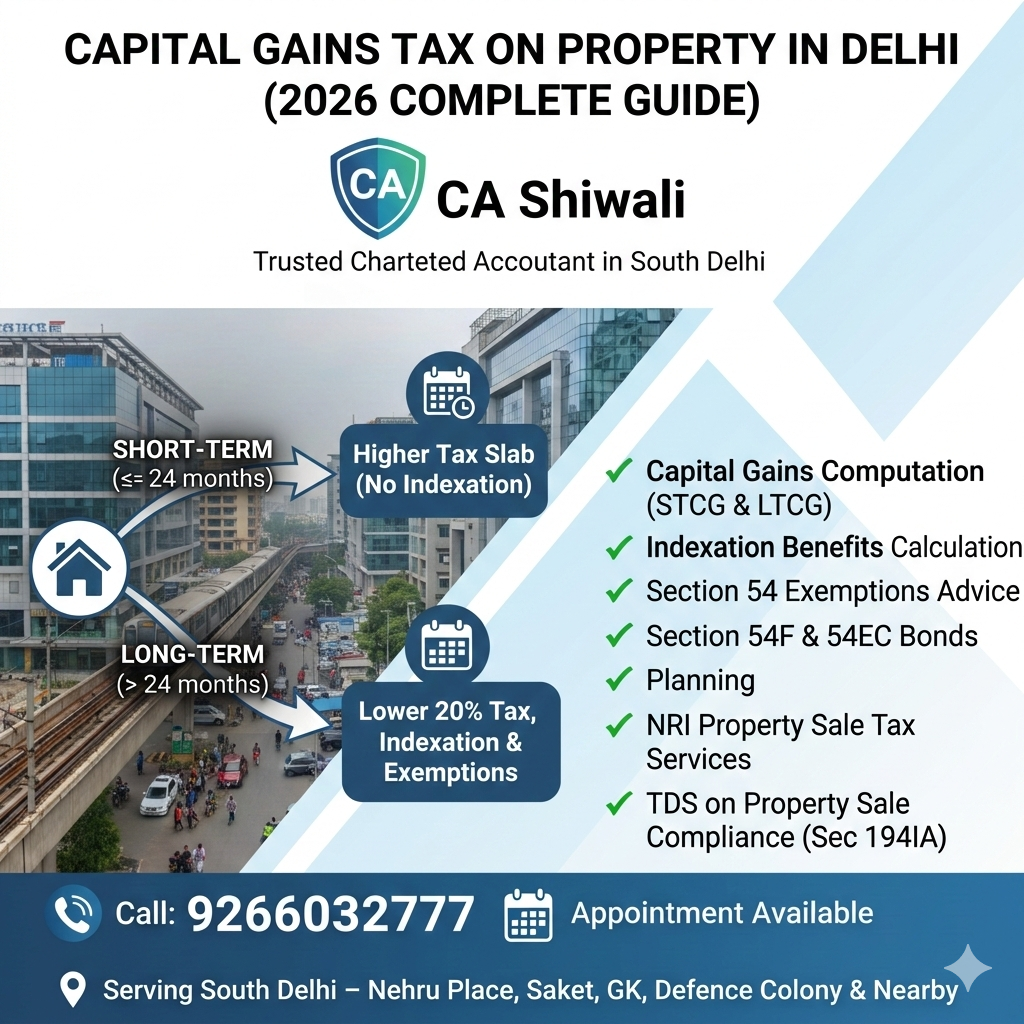
Selling a property in Delhi can be financially rewarding, but without proper planning, capital gains tax can significantly reduce your actual profit. Many property owners only realize their tax liability after the sale, when options to save tax are already limited.
This detailed 2026 guide on Capital Gains Tax on Property in Delhi explains how capital gains are calculated, applicable tax rates, exemptions, TDS rules, and how expert planning can legally reduce your tax burden.
📞 Property Tax Consultation: 9266032777
📍 Serving South Delhi – Nehru Place, Saket, GK, Defence Colony & nearby areas
What Is Capital Gains Tax on Property?
Capital gains tax is levied on the profit earned from selling a property.
The profit is calculated as:
Sale Price – Purchase Cost – Allowed Expenses
The tax treatment depends on how long you held the property before selling it.
Types of Capital Gains on Property
1️⃣ Short-Term Capital Gain (STCG)
If a property is sold within 24 months of purchase, the gain is treated as Short-Term Capital Gain.
Key Points:
Taxed as per your income tax slab
No indexation benefit
No Section 54 exemption available
This is common in cases where property is sold within 1–2 years due to relocation or liquidity needs.
2️⃣ Long-Term Capital Gain (LTCG)
If a property is sold after 24 months, the gain becomes Long-Term Capital Gain.
Key Benefits:
Flat 20% tax rate
Indexation benefit available
Multiple exemption options
For most South Delhi property owners, LTCG planning makes a huge difference in net returns.
How Capital Gains on Property Are Calculated (With Example)
Example (Delhi Property):
Purchase Price (2012): ₹60,00,000
Sale Price (2026): ₹1,60,00,000
Indexed Cost (after indexation): ₹95,00,000
Capital Gain = ₹65,00,000
Tax without planning = ₹13,00,000+
Tax with exemptions = Significantly reduced or Nil
This is why pre-sale consultation is critical.
Indexation Benefit Explained Simply
Indexation adjusts your purchase cost for inflation using Cost Inflation Index (CII).
It increases your cost base, thereby reducing taxable gains.
Indexation is allowed only in Long-Term Capital Gains.
Capital Gains Tax Saving Options (Legal Ways)



4
✅ Section 54 – Purchase of New Residential Property
Applicable when selling a residential property
New house must be purchased within prescribed time
Capital gains invested = tax saved
✅ Section 54F – When Selling Non-Residential Property
Applicable if selling land or commercial property
Entire sale proceeds must be reinvested
Useful for investors
✅ Section 54EC – Capital Gains Bonds
Investment in NHAI / REC bonds
Lock-in period applies
Ideal when you don’t want to buy property again
TDS on Property Sale – Section 194IA
If the sale value exceeds ₹50 lakh, the buyer must deduct 1% TDS and deposit it with the government.
Important Points:
Buyer files Form 26QB
Seller claims TDS credit in ITR
Incorrect deduction leads to notices
Many disputes arise because buyers are unaware of this obligation.
NRI Property Sale – Additional Tax Rules
NRIs face higher TDS (20%+) on property sale in India.
Key aspects:
Capital gains calculated differently
Lower TDS certificate can reduce blockage
Form 15CA & 15CB mandatory for repatriation
Advance planning saves lakhs for NRI sellers.
Common Capital Gains Mistakes Property Owners Make
Consulting after sale is completed
Not claiming indexation properly
Missing Section 54 timelines
Buyer not deducting TDS correctly
Ignoring joint ownership implications
These mistakes often result in avoidable tax and penalties.
Why Property Owners in Delhi Consult CA Shiwali
Specialized in Property & Capital Gains Tax
Experience with South Delhi property transactions
NRI tax & repatriation expertise
Practical, legal tax-saving strategies
Transparent professional approach
Whether you’re selling a flat in GK, a plot in Sainik Farms, or inherited property in South Delhi, correct tax planning protects your wealth.
Who Should Take Capital Gains Consultation?
You should consult before selling if:
Property value exceeds ₹50 lakh
You’re selling within 2 years
You’re an NRI
Property is jointly owned
You plan to reinvest proceeds
You received buyer TDS queries
Frequently Asked Questions – Capital Gains Tax on Property
Is capital gains tax applicable on inherited property?
Yes. Capital gains apply at the time of sale. Holding period is calculated from original owner’s purchase date.
Can capital gains tax be zero?
Yes, with proper reinvestment under Sections 54, 54F, or 54EC.
What happens if I don’t pay capital gains tax?
Interest, penalty, and scrutiny notices may be issued.
Can I save tax if I already sold property?
Limited options remain. Planning is always better before sale.
Location Coverage – Delhi NCR
Capital gains advisory provided for:
South Delhi
Nehru Place
Saket
Malviya Nagar
Greater Kailash
Defence Colony
Sainik Farms
Deoli–Khanpur
Book Capital Gains Consultation Today
Selling property without tax planning can cost you lakhs.
📞 Call 9266032777
📍 Capital Gains Tax Consultant – South Delhi
Professional advice today ensures peace of mind tomorrow.