- Our Services
- Capital Gains Tax (Save Tax on Property Sale)
- Save Capital Gains Tax (Section 54 / 54F)
- Section 50C (Stamp Duty Rule)
- CGAS Scheme
- Fair Market Value (FMV) for Capital Gains 2001
- Joint Property Sale Tax
- NRI Taxation (Property & ITR)
- TDS on NRI Property
- NRI Avoid DTAA/ ITR Filing
- Repatriation
- NRI Property Sale Tax
- Income Tax Notice Help ⚡
- Scrutiny Cases
- Income Tax Notice Reply
- GST Notices
- Tax Notice 143
- Calculate Capital Gains Tax (Free Tool)
- Company / LLP Registration
- GST Registration & Filing
- ITR Filing Services
- About CA Shiwali
- Tax Blog/ Guide
- Contact
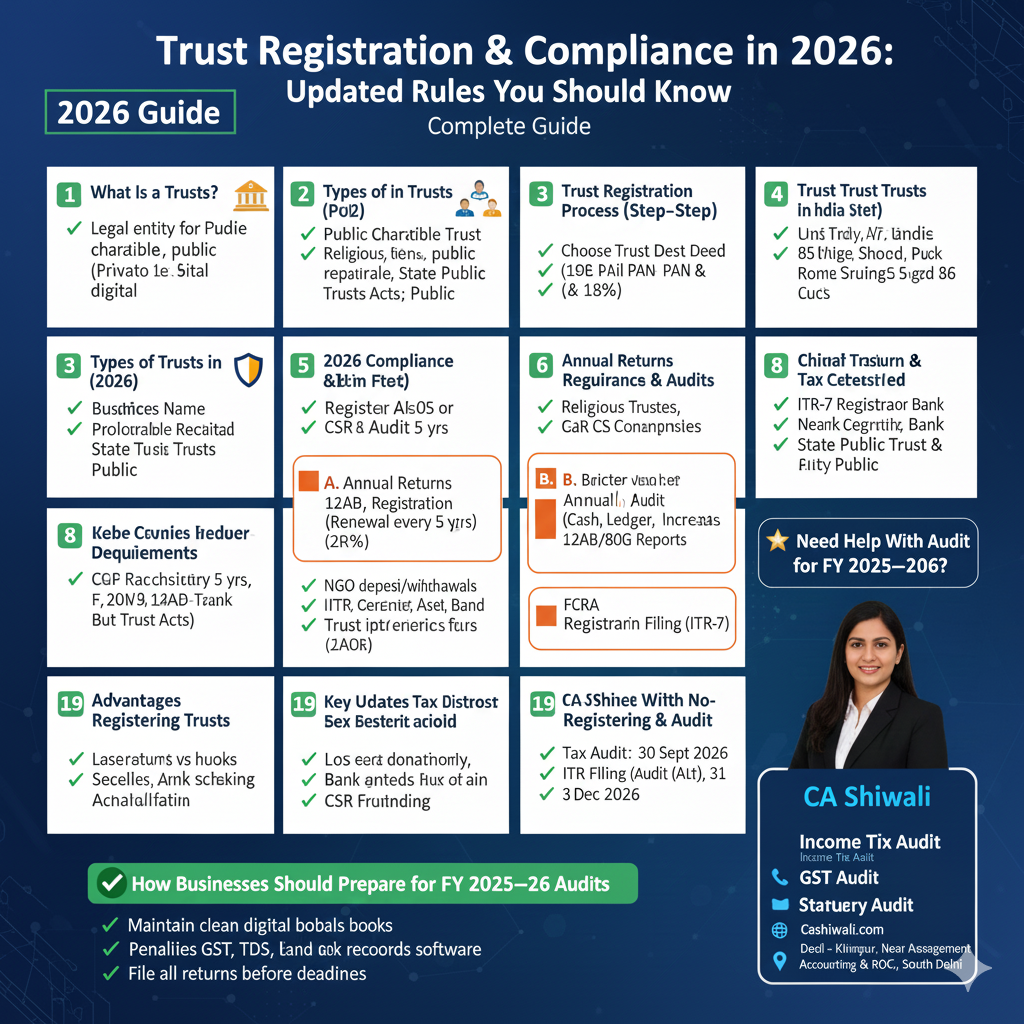
Trust Registration & Compliance in 2026: Updated Rules You Should Know (Complete Guide)
Setting up a trust in India is one of the most effective ways to carry out charitable, social, educational, or religious activities. But in 2026, the government has tightened regulations and compliance requirements for trusts, NGOs, and societies.
If you’re planning to register a trust in 2026 or already manage one, this guide explains everything—registration steps, documentation, compliance rules, due dates, and new updates introduced for FY 2025–26.
1️⃣ What Is a Trust? (Simple Explanation)
A trust is a legal entity created to manage property or funds for charitable, educational, or public welfare purposes.
In India, trusts are mainly registered under:
Indian Trusts Act, 1882 (Private Trusts)
State Public Trusts Acts (Public Charitable/Religious Trusts)
2️⃣ Types of Trusts in India (2026)
In 2026, you can register any of the following:
✔ Public Charitable Trust
For charitable activities like education, healthcare, women welfare, etc.
✔ Religious Trust
For managing temples, religious services, and spiritual activities.
✔ Private Trust
Used for family wealth management and succession planning.
✔ Society or Section 8 Company (Alternative)
Many NGOs are shifting to Section 8 Companies due to better credibility.
3️⃣ Trust Registration Process in 2026 (Step-by-Step)
Step 1: Choose Trust Name
The name must be unique and not similar to existing registered trusts.
Step 2: Prepare Trust Deed
This is the most important legal document. It includes:
Trust Name
Registered Office Address
Objectives
Details of Trustees
Rules & Powers
Management Structure
Step 3: Choose Trustees
A trust must have minimum 2 trustees (some states require 3).
Step 4: Register the Deed with the Sub-Registrar
The founder and trustees must physically visit the registrar office.
Documents required:
Aadhaar & PAN of trustees
Electricity bill/utility bill
Passport-size photos
Trust deed (2 copies)
NOC from property owner (if rented)
Step 5: Apply for PAN & Bank Account
After registration, apply for a PAN Card and open a bank account.
Step 6: Apply for 12AB & 80G Registration
This is mandatory for receiving donations and tax exemptions.
4️⃣ Mandatory Registrations for Trusts in 2026
✔ 12AB Registration
Required for availing income tax exemption.
Renewal required every 5 years.
✔ 80G Registration
Enables donors to claim tax deduction.
✔ CSR Eligibility
For receiving corporate donations under CSR Schedule VII.
✔ NGO Darpan Registration
Mandatory for receiving government grants.
✔ FCRA Registration (if foreign donations)
Required for receiving funds from abroad.
5️⃣ 2026 Compliance Requirements for Trusts
These rules are more strict than earlier years. Trusts must comply with:
🟧 A. Annual Returns & Audits
Income Tax Return (ITR-7)
Annual Audit (if income > ₹2,50,000)
12AB Compliance Report
80G Donation Report (Form 10BD & 10BE)
🟧 B. Book-Keeping Requirements
Maintain:
Cash book
Ledger
Asset register
Donation receipts
Utilization records
Bank statements reconciliation
Auditors are instructed to review digital bookkeeping in FY 2025–26.
🟧 C. GST Compliance (If Applicable)
Trusts offering:
training programs
skill development
commercial services
must register under GST.
🟧 D. CSR Reporting
CSR-eligible trusts must file:
Activity reports
Impact assessment
CSR utilization certificate
6️⃣ Key Updates for Trusts in FY 2025–26 (Important!)
✔ Stricter 80G Donation Reporting
All donations must be linked with donor PAN and reported in Form 10BD.
✔ Tighter Audit Trail Rules
Accounting systems must maintain a non-editable audit log.
✔ FCRA Scrutiny Increased
Foreign funds will undergo enhanced verification.
✔ Trust Transparency Norms Updated
Annual activity details must match tax filings.
7️⃣ Penalties for Non-Compliance (2026)
Trusts may face:
Loss of 80G & 12AB
Heavy penalties under Income Tax Act
Freezing of bank accounts (for FCRA cases)
CSR funding ban
Income tax reassessment
Registration cancelation
8️⃣ Advantages of Registering a Trust in 2026
100% legal protection
Eligibility for tax exemption
Can receive donations legally
Eligible for CSR funding
Better credibility & transparency
Ideal for schools, clinics, religious bodies, skill centers, NGOs
⭐ Conclusion
Running a trust in 2026 requires strong compliance and transparent financial management. With stricter donation reporting, audit requirements, and digital record rules, it’s important to stay updated and file all forms before the due dates.
If you’re planning to start a trust or need help maintaining compliance, expert help from a CA ensures full legal safety.
🟢 Need Help With Trust Registration or Compliance?
CA Shiwali provides:
Trust Registration
12AB & 80G Registration
Trust Accounting & Audit
CSR Compliance
FCRA Assistance
Annual Return Filing (ITR-7)
📞 9266032777
🌐 www.Cashiwali.com
📍 Deoli – Khanpur, Near Saket, South Delhi
Direct Consultation with CA Shiwali Dagar
Expert tax planning and compliance services tailored for NRIs, property owners, and businesses. Get professional clarity on your complex tax matters today.
Strategic Planning
- ✔ Capital Gains (Sec 54/54F)
- ✔ FMV Valuation (Pre-2001)
- ✔ NRI TDS & Form 13
Tax Compliance
- ✔ IT Notice Resolution
- ✔ 15CA & 15CB Certificates
- ✔ GST & Statutory Audits
Start Your Consultation
Whatspp CA Shiwali Now Call CA Shiwali nowProven Results. Online & Offline.