- Our Services
- Capital Gains Tax (Save Tax on Property Sale)
- Save Capital Gains Tax (Section 54 / 54F)
- Section 50C (Stamp Duty Rule)
- CGAS Scheme
- Fair Market Value (FMV) for Capital Gains 2001
- Joint Property Sale Tax
- NRI Taxation (Property & ITR)
- TDS on NRI Property
- NRI Avoid DTAA/ ITR Filing
- Repatriation
- NRI Property Sale Tax
- Income Tax Notice Help ⚡
- Scrutiny Cases
- Income Tax Notice Reply
- GST Notices
- Tax Notice 143
- Calculate Capital Gains Tax (Free Tool)
- Company / LLP Registration
- GST Registration & Filing
- ITR Filing Services
- About CA Shiwali
- Tax Blog/ Guide
- Contact
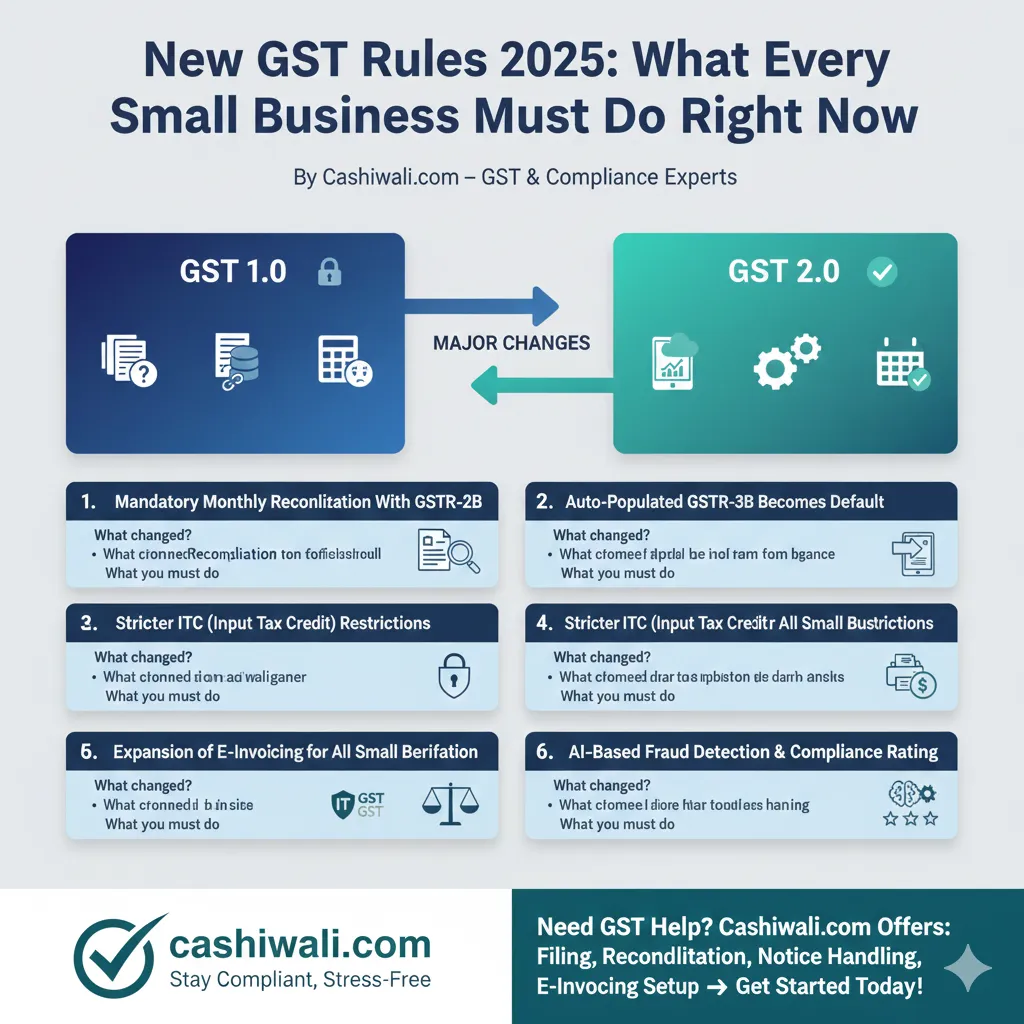
New GST Rules 2025: What Every Small Business Must Do Right Now
By Cashiwali.com – GST & Compliance Experts
The year 2025 brings major changes to India’s GST framework.
The government is moving towards a more transparent, automated, and data-driven compliance system, often referred to as GST 2.0.
These new rules directly impact small businesses, MSMEs, shop owners, service providers, freelancers, and online sellers.
This article breaks down all the important GST changes in 2025 and explains exactly what your business must do to stay compliant.
⭐ 1. Mandatory Monthly Reconciliation With GSTR-2B
The GST department now relies heavily on GSTR-2B, an auto-drafted ITC statement.
✔ What changed?
Businesses can claim ITC only if the supplier uploads invoices in GSTR-1 → reflecting in your GSTR-2B.
✔ What you must do
Reconcile purchases every month
Follow up with vendors who don’t file GSTR-1 on time
Claim ITC only when it appears in GSTR-2B
Stop working with non-compliant suppliers
⭐ 2. Auto-Populated GSTR-3B Becomes Default
✔ What changed?
GSTR-3B is now auto-filled based on:
Your GSTR-1
E-invoices
E-way bills
GSTR-2B
Any mismatch auto-triggers a notice.
✔ What you must do
Double-check auto-populated figures
Report accurate outward supplies in GSTR-1
Ensure e-invoicing is error-free
⭐ 3. Stricter ITC (Input Tax Credit) Restrictions
GST 2025 has become much stricter:
No provisional ITC
Only matched invoices allowed
Suspicious transactions → automatic ITC blocking
Missed vendor filings → immediate ITC loss
✔ What you must do
Maintain vendor compliance score
Track filing status of all suppliers
Use digital tools for monthly ITC reconciliation
⭐ 4. Expansion of E-Invoicing for All Small Businesses
✔ What changed?
In 2025, e-invoicing is now mandatory for businesses with turnover above ₹5 crore (expected to drop further).
✔ What you must do
Use software that generates e-invoices automatically
Make sure invoice details match GSTR-1
Maintain a digital archive of all e-invoices
⭐ 5. GST–Income Tax Cross Verification
The government now cross-checks:
GST turnover
Bank deposits
TDS data
Profit declared in ITR
Mismatch = instant notice.
✔ What you must do
Declare the same turnover in GST and ITR
Maintain proper books of accounts
Reconcile financial statements every month
⭐ 6. AI-Based Fraud Detection & Compliance Rating
GST 2025 includes a Compliance Score (similar to CIBIL for tax).
High score = smooth ITC
Low score = automatic blocking, extra scrutiny
✔ What you must do
File returns on time
Avoid mismatches
Keep HSN codes & tax rates accurate
File NIL returns even when inactive
⭐ 7. HSN Code & Tax Rate Accuracy Enforcement
✔ What changed?
Wrong HSN codes or incorrect tax rates can lead to:
Auto-detection
Notices
Penalties
✔ What you must do
Use the correct HSN/SAC code for every product/service
Update your billing software
Train your team
⭐ 8. Stricter Penalties for Late Filing
Late GSTR-1 or GSTR-3B in 2025 can trigger:
Late fees
Suspension of GST number
Blocking of e-way bills
Blocking of ITC
✔ What you must do
File returns before the due date, every month
Use GST reminders or automation tools
Avoid last-day rush
⭐ 9. Verification of Beneficial Owners & Directors
For companies and LLPs, the department now verifies:
PAN
Aadhaar
Address
Bank KYC
Any mismatch can lead to GSTIN suspension.
✔ What you must do
Ensure KYC of all directors/partners is updated
Use a clean bank account for business
⭐ 10. Tighter Monitoring of Cash Transactions
GST now monitors:
Cash deposits
Cash sales
Cash purchases
Cash payments above limits
Suspicious cash activity auto-triggers investigation.
✔ What you must do
Shift to digital payments
Maintain proper invoices
Avoid cash beyond allowed limits
🎯 Final Summary: What Small Businesses Must Do in 2025
To stay safe and compliant:
Reconcile ITC every month
File GSTR-1 & 3B on time
Use e-invoicing software
Keep books clean & updated
Match GST turnover with ITR
Work only with compliant suppliers
Train your staff in GST 2.0 changes
Doing this ensures:
✔ No notices
✔ No penalties
✔ No ITC blockage
✔ Smooth business operations
⭐ Need GST Help? Cashiwali.com Has You Covered
We assist small businesses with:
GST Filing
GST Reconciliation
GST Notice Handling
Return Correction
E-Invoicing Setup
Accounting & Compliance
👉 Stay compliant in 2025 with the experts at Cashiwali.com
Direct Consultation with CA Shiwali Dagar
Expert tax planning and compliance services tailored for NRIs, property owners, and businesses. Get professional clarity on your complex tax matters today.
Strategic Planning
- ✔ Capital Gains (Sec 54/54F)
- ✔ FMV Valuation (Pre-2001)
- ✔ NRI TDS & Form 13
Tax Compliance
- ✔ IT Notice Resolution
- ✔ 15CA & 15CB Certificates
- ✔ GST & Statutory Audits
Start Your Consultation
Whatspp CA Shiwali Now Call CA Shiwali nowProven Results. Online & Offline.