- Our Services
- Capital Gains Tax (Save Tax on Property Sale)
- Save Capital Gains Tax (Section 54 / 54F)
- Section 50C (Stamp Duty Rule)
- CGAS Scheme
- Fair Market Value (FMV) for Capital Gains 2001
- Joint Property Sale Tax
- NRI Taxation (Property & ITR)
- TDS on NRI Property
- NRI Avoid DTAA/ ITR Filing
- Repatriation
- NRI Property Sale Tax
- Income Tax Notice Help ⚡
- Scrutiny Cases
- Income Tax Notice Reply
- GST Notices
- Tax Notice 143
- Calculate Capital Gains Tax (Free Tool)
- Company / LLP Registration
- GST Registration & Filing
- ITR Filing Services
- About CA Shiwali
- Tax Blog/ Guide
- Contact
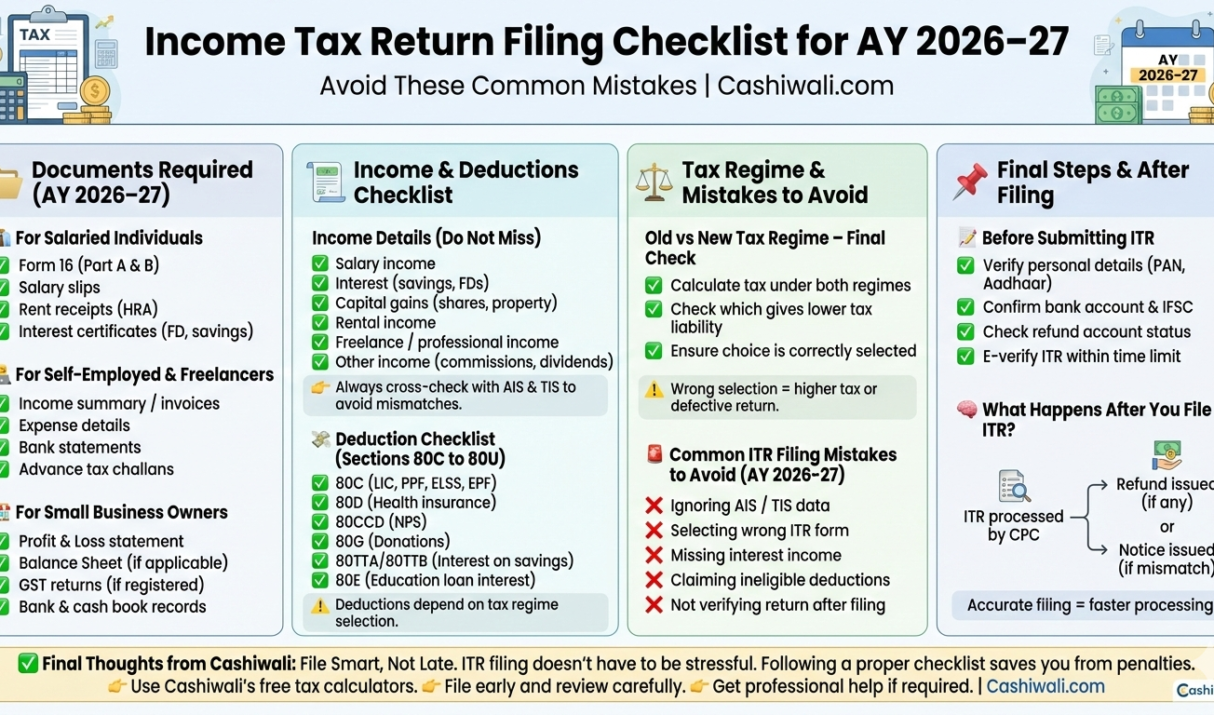
Income Tax Return Filing Checklist for AY 2026–27 (Avoid These Common Mistakes)
Filing your Income Tax Return (ITR) for AY 2026–27 is not just about submitting a form. A small mistake can lead to refund delays, notices, or penalties.
This complete checklist will help salaried individuals, self-employed professionals, and small business owners file their ITR accurately and on time.
✅ Who Should File Income Tax Return for AY 2026–27?
You should file an ITR if you:
Have total income above basic exemption limit
Earn salary, business, professional, or freelance income
Have interest, capital gains, or rental income
Want to claim a tax refund
Have foreign assets or income
Paid advance tax or TDS
📂 Documents Required for ITR Filing (AY 2026–27)
👔 For Salaried Individuals
✔ Form 16 (Part A & B)
✔ Salary slips
✔ Rent receipts (if claiming HRA)
✔ Interest certificates (FD, savings)
🧑💻 For Self-Employed & Freelancers
✔ Income summary / invoices
✔ Expense details
✔ Bank statements
✔ Advance tax payment challans
🏪 For Small Business Owners
✔ Profit & Loss statement
✔ Balance Sheet (if applicable)
✔ GST returns (if registered)
✔ Bank & cash book records
🧾 Income Details Checklist (Do Not Miss These)
✔ Salary income
✔ Interest from savings & FDs
✔ Capital gains (shares, property, mutual funds)
✔ Rental income
✔ Freelance / professional income
✔ Other income (commissions, dividends)
👉 Always cross-check with AIS & TIS to avoid mismatches.
💸 Deduction Checklist (Sections 80C to 80U)
✔ 80C – LIC, PPF, ELSS, EPF
✔ 80D – Health insurance
✔ 80CCD – NPS
✔ 80G – Donations
✔ 80TTA / 80TTB – Interest on savings
✔ 80E – Education loan interest
⚠️ Deductions depend on tax regime selection.
⚖️ Old vs New Tax Regime – Final Check
Before filing your ITR:
Calculate tax under both regimes
Check which gives lower tax liability
Ensure your choice is correctly selected in the return
👉 Wrong selection = higher tax or defective return
📆 Advance Tax & Self-Assessment Tax Checklist
✔ Check if advance tax was required
✔ Pay self-assessment tax if any balance remains
✔ Ensure challan details are entered correctly
🚨 Common ITR Filing Mistakes to Avoid (AY 2026–27)
❌ Ignoring AIS / TIS data
❌ Selecting wrong ITR form
❌ Missing interest income
❌ Claiming deductions not allowed in chosen regime
❌ Not verifying return after filing
📌 Final Steps Before Submitting ITR
✔ Verify personal details (PAN, Aadhaar, address)
✔ Confirm bank account & IFSC
✔ Check refund account status
✔ E-verify ITR within time limit
🧠 What Happens After You File ITR?
ITR is processed by CPC
Refund (if any) is issued
Notice may be issued if mismatch exists
Accurate filing = faster processing
✅ Final Thoughts: File Smart, Not Late
ITR filing for AY 2026–27 doesn’t have to be stressful.
Following a proper checklist can save you from penalties, notices, and refund delays.
👉 Use Cashiwali’s free tax calculators
👉 File early and review carefully
👉 Get professional help if required
Frequently Asked Questions (FAQs) – ITR Filing AY 2026–27
1. Who is required to file an Income Tax Return for AY 2026–27?
Any individual whose total income exceeds the basic exemption limit, or who wants to claim a refund, has foreign assets, or has paid advance tax or TDS, should file an ITR for AY 2026–27.
2. What documents are required for filing ITR for AY 2026–27?
Common documents include Form 16 (for salaried individuals), bank statements, interest certificates, investment proofs, income details, and advance tax challans, if applicable.
3. Is it mandatory to check AIS and TIS before filing ITR?
Yes. AIS (Annual Information Statement) and TIS (Taxpayer Information Summary) help ensure that all income reported to the tax department is correctly included in your return, reducing chances of mismatch or notice.
4. Can I revise my income tax return if I make a mistake?
Yes. If you discover an error after filing, you can file a revised return within the permitted time limits as prescribed under the Income Tax Act.
5. What happens if I choose the wrong tax regime while filing ITR?
Choosing the wrong tax regime may result in higher tax liability or rejection of certain deductions. In some cases, the return may need to be revised.
6. Is advance tax applicable for AY 2026–27?
Advance tax provisions continue to apply. Individuals with income beyond salary, professionals, and business owners may be required to pay advance tax to avoid interest and penalties.
7. What is the most common mistake taxpayers make while filing ITR?
The most common mistake is missing income reported in AIS/TIS or filing the return without proper verification, which can delay processing or refunds.
8. Is e-verification mandatory after filing ITR?
Yes. An income tax return is considered incomplete unless it is e-verified within the prescribed time. Failure to verify may invalidate the filing.
Direct Consultation with CA Shiwali Dagar
Expert tax planning and compliance services tailored for NRIs, property owners, and businesses. Get professional clarity on your complex tax matters today.
Strategic Planning
- ✔ Capital Gains (Sec 54/54F)
- ✔ FMV Valuation (Pre-2001)
- ✔ NRI TDS & Form 13
Tax Compliance
- ✔ IT Notice Resolution
- ✔ 15CA & 15CB Certificates
- ✔ GST & Statutory Audits
Start Your Consultation
Whatspp CA Shiwali Now Call CA Shiwali nowProven Results. Online & Offline.