- Our Services
- Capital Gains Tax (Save Tax on Property Sale)
- Save Capital Gains Tax (Section 54 / 54F)
- Section 50C (Stamp Duty Rule)
- CGAS Scheme
- Fair Market Value (FMV) for Capital Gains 2001
- Joint Property Sale Tax
- NRI Taxation (Property & ITR)
- TDS on NRI Property
- NRI Avoid DTAA/ ITR Filing
- Repatriation
- NRI Property Sale Tax
- Income Tax Notice Help ⚡
- Scrutiny Cases
- Income Tax Notice Reply
- GST Notices
- Tax Notice 143
- Calculate Capital Gains Tax (Free Tool)
- Company / LLP Registration
- GST Registration & Filing
- ITR Filing Services
- About CA Shiwali
- Tax Blog/ Guide
- Contact
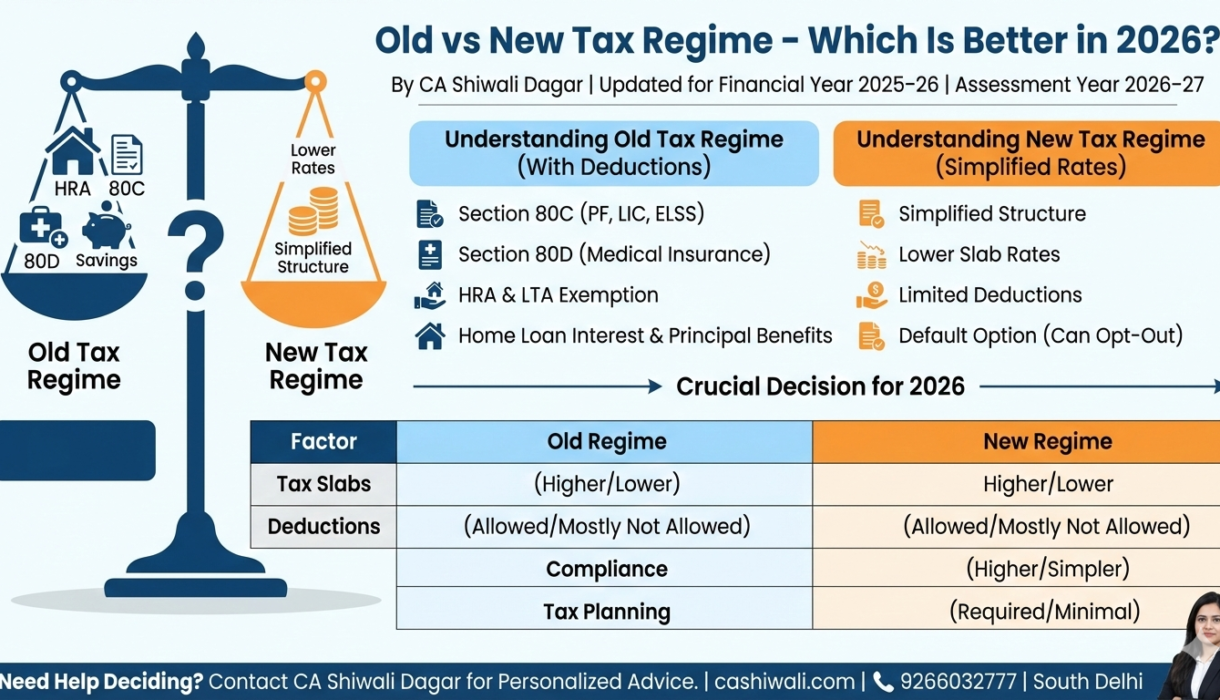
Old vs New Tax Regime – Which Is Better in 2026?
Author: CA Shiwali Dagar
Updated for: Financial Year 2025–26 | Assessment Year 2026–27
Confused Between Old and New Tax Regime?
One of the most common questions taxpayers ask in 2026 is:
Should I choose the Old Tax Regime or the New Tax Regime?
The answer is not the same for everyone. Choosing the wrong regime can lead to higher tax outgo, missed deductions, or future regret.
This article explains the real differences, hidden factors, and practical decision-making approach—not just slab comparison.
Understanding the Old Tax Regime
The Old Tax Regime allows various deductions and exemptions, making it suitable for taxpayers with structured savings and expenses.
Key Benefits of Old Tax Regime
Section 80C deductions (PF, LIC, ELSS, etc.)
Section 80D (medical insurance)
HRA exemption
Leave Travel Allowance (LTA)
Home loan interest & principal benefits
Who Should Consider Old Regime?
Salaried individuals with HRA
Home loan borrowers
Taxpayers investing regularly
Individuals with medical insurance
Understanding the New Tax Regime
The New Tax Regime offers lower tax rates but removes most exemptions and deductions.
Key Features of New Tax Regime
Simplified structure
Lower slab rates
Limited deductions allowed
Suitable for those with minimal tax-saving investments
Important: The New Tax Regime is now the default regime, but taxpayers can still opt out where permitted.
Common Myth: New Tax Regime Is Always Better ❌
Many taxpayers assume the new regime automatically saves tax. This is not always true.
In many real-life cases, taxpayers under the old regime still pay less tax after deductions.
Practical Comparison – Old vs New Tax Regime
| Factor | Old Regime | New Regime |
|---|---|---|
| Tax Slabs | Higher | Lower |
| Deductions | Allowed | Mostly Not Allowed |
| Compliance | Higher | Simpler |
| Tax Planning | Required | Minimal |
Special Considerations for 2026
Salaried Employees
HRA and 80C still play a major role
Employer salary structure matters
Senior Citizens
Medical deductions & interest exemptions favor old regime
PSU & Bank Employees
Retirement benefits taxation must be evaluated carefully
Can You Change Tax Regime Every Year?
Salaried taxpayers: Can switch every year
Business/professional income: Restricted after selection
This makes one-time wrong decisions costly for business owners.
How CA Shiwali Dagar Helps You Choose Correctly
✔ Personalized tax comparison
✔ Salary & income structure analysis
✔ Long-term tax impact evaluation
✔ Compliance-safe regime selection
The decision is taken based on numbers, not assumptions.
Frequently Asked Questions
Is the new tax regime compulsory?
No. It is the default option, but eligible taxpayers can opt for the old regime.
Which tax regime is better for salaried employees?
It depends on deductions, HRA, investments, and salary structure.
Can wrong selection cause issues later?
Yes. Incorrect selection may lead to higher tax liability or loss of benefits.
Contact CA Shiwali Dagar for Tax Regime Advice
📍 South Delhi
📞 Phone: 9266032777
🌐 Website: https://cashiwali.com
Final Thought
Tax planning is not about following trends—it is about choosing what works best for your situation.
Before selecting a tax regime in 2026, take professional advice.
Related Reads:
Salary & Retirement Tax Planning
Direct Consultation with CA Shiwali Dagar
Expert tax planning and compliance services tailored for NRIs, property owners, and businesses. Get professional clarity on your complex tax matters today.
Strategic Planning
- ✔ Capital Gains (Sec 54/54F)
- ✔ FMV Valuation (Pre-2001)
- ✔ NRI TDS & Form 13
Tax Compliance
- ✔ IT Notice Resolution
- ✔ 15CA & 15CB Certificates
- ✔ GST & Statutory Audits
Start Your Consultation
Whatspp CA Shiwali Now Call CA Shiwali nowProven Results. Online & Offline.